


Somewhere over the last year, “using AI” quietly stopped being a differentiator for software engineers. Once everyone reaches that baseline, the baseline itself stops mattering – the real difference is what happens beyond it. Earlier in this series, we explored how AI is reshaping software engineering rather than replacing it, and where those changes are already appearing in day-to-day work. The more interesting question now is where an engineer sits on the curve beyond simply using AI – because saying “I use AI” no longer tells you very much.
The numbers reflect that shift. JetBrains reported developer AI adoption at 90% in its January 2026 survey of more than 10,000 professionals, while Stack Overflow’s latest figures show 84% of developers are either using or planning to use AI tools, up from around 70% two years ago. But these numbers describe the new baseline, not the gap between engineers. They show that AI is no longer optional; they don’t show who is using it effectively.
THE FLOOR
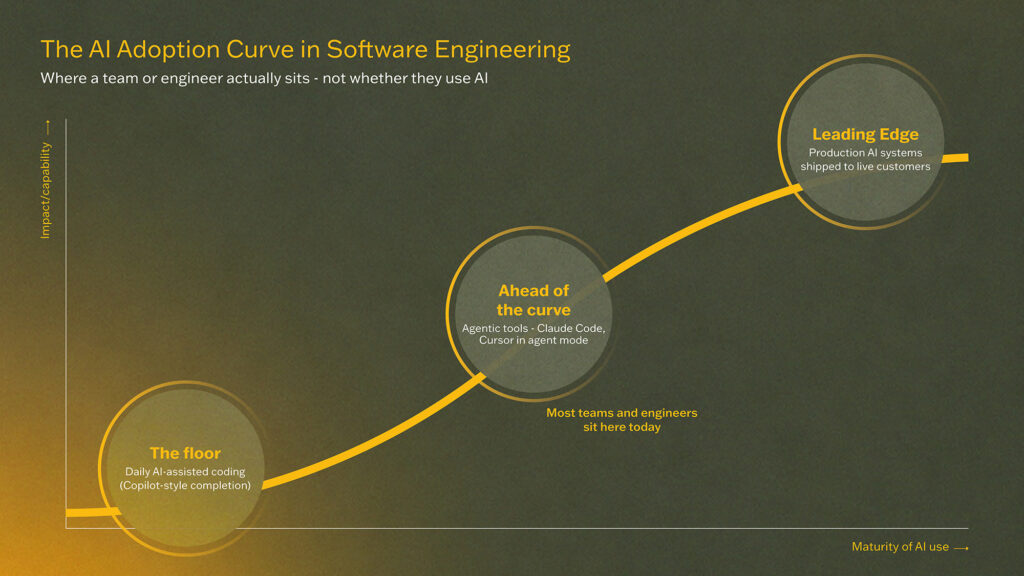
From my experience working with software engineering teams, the baseline has shifted significantly over the past 12 months. Daily use of an AI coding assistant is no longer a differentiator; it’s the minimum expectation.
GitHub Copilot still dominates enterprise adoption, particularly within larger organisations where Microsoft ecosystems make it the natural choice. However, when I’m speaking with clients hiring engineers with AI experience, Copilot is rarely enough on its own. More and more, employers are looking for developers who have moved beyond AI-assisted autocomplete and have gained practical experience using more advanced AI tools (which we’ll explore next) as part of their everyday development workflow.
Many larger organisations are understandably slower to adopt newer AI tooling because they’re already invested in existing enterprise platforms. The result is that talented engineers can find themselves at a disadvantage when they enter the job market, simply because they haven’t had the chance to work with tools that are becoming common elsewhere. GitHub Copilot is the floor. It’s still valuable, but relying on it alone leaves engineers behind where the market is moving.
AHEAD OF THE CURVE
The next tier is agentic AI: tools that can reason through problems, plan multi-step tasks, modify codebases, and execute increasingly complex engineering workflows with far less manual intervention.
From what I’m seeing in the market, this is where the biggest shift is happening. Over the past year, tools like Claude Code have seen growing adoption, with many teams exploring options beyond traditional AI coding assistants such as GitHub Copilot. Cursor has also become a regular topic of discussion with both clients and talent, reflecting a broader move towards more advanced AI-assisted development.
That shift is also why personal learning matters more than many realise. In hiring conversations, saying you’re interested in AI is no longer enough. For example, if you’re using GitHub Copilot in your current role but interviewing for a position where the team is using tools like Claude Code, and you haven’t spent any time exploring those technologies yourself, it’s difficult to demonstrate genuine interest in AI or show that you’re keeping pace with how quickly the space is evolving.
The engineers who stand out are the ones who make time to experiment — building personal projects, testing new tools, sharing what they learn, or finding practical ways to apply AI outside their day-to-day role. They don’t need to be experts in every new platform, but they do need to demonstrate curiosity and the ability to adapt as the technology evolves.
LEADING EDGE
The third tier is where the gap is still most visible: organisations building and deploying AI systems into production, rather than simply using AI to support development. Six months ago, very few companies had reached this stage. In recent months, there has definitely been an uplift in organisations moving AI systems into production, but it is still a minority. Plenty are experimenting with agentic AI, running pilots and proofs of concept, but the real differentiator now is the ability to turn those experiments into reliable, scalable systems that deliver value in practice.
Forrester’s 2026 research found around 75% of enterprises are adopting agentic AI, while Gartner predicts that more than 40% of agentic AI projects will be cancelled before the end of 2027 due to factors such as cost, unclear business value and risk management challenges. We’ll explore the cost of AI in more detail in a later article.
When clients are specifically asking for agentic AI experience, the frameworks I most commonly see referenced are LangChain and LangGraph, largely because they have gained significant traction among engineering teams building LLM-powered applications and agent workflows.
That said, they are far from the only options. Frameworks such as CrewAI, Semantic Kernel, Google’s ADK and Microsoft’s Agent Framework are all competing for adoption, each taking slightly different approaches to building and orchestrating AI agents. The lack of a clear market leader is a sign of how early this space still is. For organisations, the focus is increasingly less on a single framework and more on finding engineers who understand the underlying concepts: designing agent workflows, integrating models and tools, managing context, evaluating performance, and building reliable systems that can move beyond experimentation into production.
Sources
- JetBrains AI Pulse Survey, January 2026 (10,000+ professional developers)
- Stack Overflow 2025/2026 Developer Survey; Stack Overflow Blog, “Closing the developer AI trust gap,” Feb 2026
- Forrester Research, 2026 agentic AI enterprise adoption findings
- Gartner, “Gartner Predicts Over 40% of Agentic AI Projects Will Be Cancelled by End of 2027,” press release, 2025–26
- LangChain resources: “The best AI agent frameworks in 2026”
Connect with Rachel rachel.mcguckian@barden.ie at or on LinkedIn>>>