

Every organisation embarking on a significant transformation or a period of accelerated change eventually confronts the same question: how do we manage delivery and governance, ensuring timelines and deliverables are not at risk? A Project Management Office (PMO) is often the answer. Effectively, a PMO is a central function that brings visibility, governance, consistency and delivery discipline to an organisation’s projects and programmes. The fundamental question, however, is: how do you go about building out that function, through internal capability or external consultants or a blend of both?
Over the last 12 months, Barden has supported multiple organisations in hiring across their PMO functions. In some cases, it was a single hire; in others, it was building out their entire PMO capability, including full scoping of the roles and responsibilities for our clients. A topic that arose through many of these conversations centred on one question:

In reality, there is no ‘one size fits all’ approach. It is very much dependent on your own organisation’s needs and circumstances, and some common factors that come into play include:
▪ Business requirements: are there specialist or niche skills required for this project or programme.
▪ Length of the project: short-term project versus longer-term strategic programme aligned to business strategy.
▪ Cost considerations: full-time employees versus short-term contractor costs.
▪ Maturity of the organisation: whether current PM resources already exist and are fully absorbed and therefore not accessible.
▪ Access to talent on the market: in particular for niche requirements.
▪ Importance of flexibility: if this is a short-term need, then flexibility to remove costs upon completion of the projectwill likely be a key factor
Often organisations will adopt a hybrid approach, combining internal talent with consultant support for niche or specialist requirements. Let’s explore the considerations for both below.
Building Internal Capability
Building your PMO in-house is an investment in long-term capability. It puts ownership, accountability and prioritisation firmly inside the organisation. Over time, it tends to be the more cost-efficient route compared with the higher expected outlay from engaging external consultants. Internal talent accumulates deep knowledge, earns trust across teams (a key consideration and should not be underestimated in terms of impact on project delivery), and stays close to the strategy the PMO function actually exists to serve. The trade-off is time and reach: hiring can take time if specialised skills are required.
Let’s look at considerations and potential drawbacks from hiring your PMO talent internally:
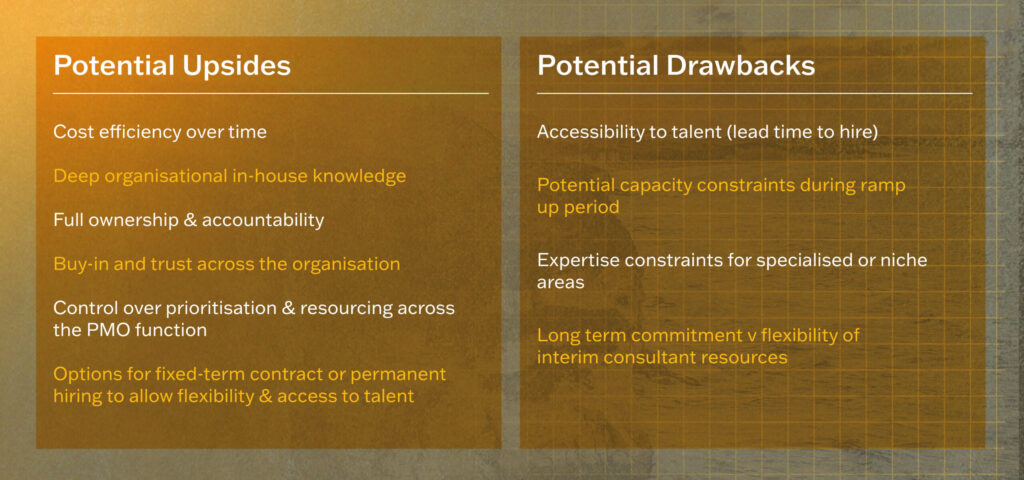
Choosing to build PMO capability internally does not commit you to a single hiring model. Alongside permanent hires, fixed-term contracts and daily-rate contract arrangements give you the flexibility to scale up or down as project demands change. This lets you bring in the right level of capability for the timeframe you need it, without over-committing on cost where the requirement is temporary. We have supported Clients who leverage varying hiring models as they grow out their PMO function.
External Consultant Support
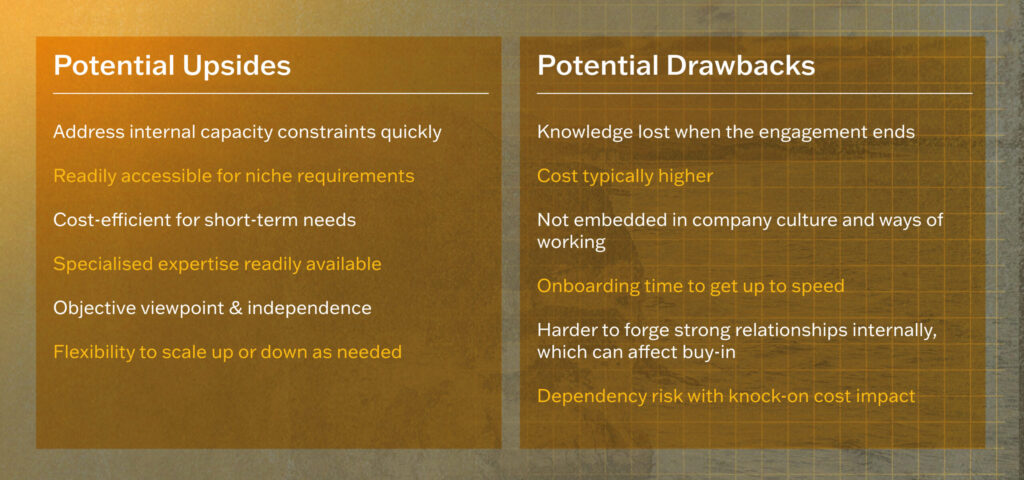
External consultants are important when speed, specialist expertise, or flexibility matter most. They can address internal capacity constraints quickly, bring niche skills that would take months to hire for, and offer an objective, independent viewpoint free of internal politics. For short-term needs, they can be the more cost-efficient option, and they can scale up or down as the work demands. The considerations are just as important: cost is typically higher, they sit outside your culture and ways of working, there is onboarding time to get up to speed, and, most importantly, hard-won knowledge can walk out the door when the engagement ends. It is worth considering because it buys capability you may not otherwise reach, exactly when you need it.
Let’s look at considerations and potential drawbacks from leveraging external consultant PMO resources:
Final Thoughts
Building internally offers ownership, cultural fit, and long-term value, but demands time and investment in the recruitment process. Engaging external partners offers flexibility, access to niche and specialised skills where needed, and objectivity, but at a cost, and with the impact that knowledge leaves when the contract ends.
Your PMO function is a key driver in the execution of your business strategy and transformation agenda. Maintaining hands-on oversight through internal talent capability, combined with external support when needed, is likely the optimal approach for most organisations.

In practice, this means establishing an in-house PMO capability while leveraging the expertise of an outsourced PMO for specialist or short-term needs. Adopting this hybrid approach ultimately addresses many of the drawbacks that apply if you rely solely on external capability. It keeps ownership and continuity inside the organisation, while staying open to specialist expertise when required.
Catherine Drysdale is Partner of Barden’s Projects, Transformation & Change Practice. Connect with Catherine at catherine.drysdale@barden.ie or on LinkedIn