

While demand for Product talent in Ireland remains strong, the role and function itself has changed significantly over the last few years, becoming more specialised and cross-functional in nature. How specialised the role and function depends on a number of factors: its product type (AI-powered versus a mature product portfolio), the market it operates in, its maturity, and the business model all shape the roles it needs. This has given rise to distinct areas of product specialism; examples of such roles include:
- Data Product Manager (ingestion, cleansing, extraction)
- Technical Product Manager
- Digital Product & Strategy Lead
- Regulatory Product Owner
- Data and AI Product Manager
Generalist Product roles haven’t disappeared, there’s still a place for them; but niche, specialised roles are increasingly what the market is producing. Additionally, the role of Product continues to become more cross-functional, and in some cases the role crosses the intersection of product to engineering, data, sales and customer success. Hence why the function is increasing in visibility across organisations.
Drawing on conversations with Product professionals and hiring managers across the industry, we examine below the key trends, insights and factors shaping Ireland’s Product landscape.
#1 Continuum of activity
Two companies can both be hiring a “Product Manager” and mean very different things. As we always say in Barden, a job spec means nothing without context. The clearest way to scope the role is to determine where the person’s involvement sits across the product lifecycle; from ideation, through validation and development, to the product being live and, in the market, (“In Life”).
Broadly, non-technical Product Managers weigh toward the front and back of the lifecycle (shaping the idea, validating the market need, and driving adoption once the product is live). Technical Product Managers weigh toward the middle, working most closely with engineering through development and delivery. Neither is more senior than the other; they solve different problems.
This distinction matters more than ever as the Product function becomes more specialised. Roles such as Data Product Manager, Technical Product Manager, Regulatory Product Owner, and Data and AI Product Manager each sit at a different point on this continuum, and cross-functional collaboration is increasingly expected at every stage of it, not just at the point of highest involvement. The percentage of an individual’s time spent on either side of this line, set against the shape of your own team, remains the single most useful thing to agree before you go to market. The strongest Product teams will combine specialist expertise with commercial judgement, customer understanding and the ability to adapt as quickly as the products they are building.
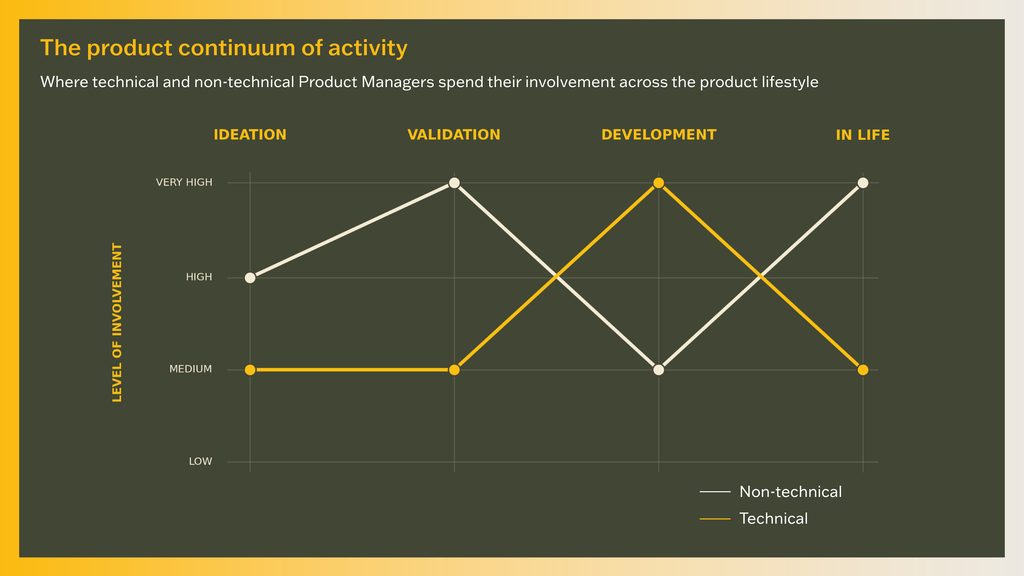
Indicative involvement across the product lifecycle. Barden view.
#2 Salary insights: Product Management in 2026
Context is important when reading any salary guide. Ranges are shaped by a mix of internal factors (the size* and maturity of the product function, the level of commercial ownership, whether the role is technical or non-technical) and external factors (sector, funding stage, and competition for the same talent). A range on its own rarely tells the full story, where a role sits within it is decided by these variables. Location is also an important factor to consider, with Dublin typically offering compensation around 15–20% higher than other regions. Below are indicative salary ranges based on recent Barden assignments.
*Larger multinational technology companies often offer base salaries circa 20% above the wider market, alongside restricted stock units (RSUs) that can significantly increase total compensation.
#3 Current Snapshot of the Product Talent Pool
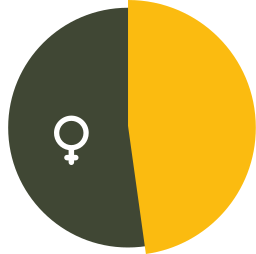
Here’s what we’ve noticed this quarter in the Product talent pool in Ireland:



#4 Key considerations for Product talent in the year ahead
Integration of AI in Product Management
The impact of Artificial Intelligence on the Product role is multi-faceted, and in truth we could write an article solely focusing on this topic, but for now we have summarised some high-level considerations below:
- AI’s direct impact on the product role: AI is already being used for tasks such as drafting vision statements, editing product requirement documents (PRDs), and generating meeting summaries. This integration aims to streamline workflows and reduce the administrative burden on product teams.
- AI’s impact on Engineering and Development: As AI accelerates delivery within Engineering and Development teams, Product faces a new capacity challenge; keeping pace and remaining agile enough to match the increased speed of build and release.
- AI for Data analysis to inform Product decisions: Product functions are rarely short of data, be that customer insights, support ticket analysis, usage analytics, etc. The challenge lies in getting the insights from that data to inform future product roadmap decisions. AI is increasingly being used to break down these silos and surface the trends and insights needed to inform a roadmap that’s genuinely aligned to organisational strategy.
Specialisation as a competitive advantage
The shift towards specialised Product roles is, in itself, a competitive advantage for talent considering a move. Employers are increasingly seeking individuals with expertise in areas such as AI, data, platform development, and growth strategy, reflecting the growing complexity of products and the specialised knowledge needed to manage them effectively. For Product professionals, now is the time to build depth in AI and data specifically: these are the specialisms employers are competing hardest for, and the ones most likely to command a premium over a generalist Product Manager background.
Increased Emphasis on Commercial Ownership
Product professionals are increasingly expected to own commercial outcomes such as profitability, improved retention leading to increased Annual Recurring Revenue (ARR), return on investment, and so on. This reflects a broader shift in how the business measures product success, and for Product professionals this requires a strong level of commercial fluency, including building a business case and defending the product roadmap in financial terms.
Shift Towards Product-Led Growth (PLG)
This growing emphasis on commercial ownership is closely linked to the rise of product-led growth (PLG), where organisations increasingly rely on the product itself to drive user acquisition, retention, and expansion. This shift necessitates product professionals to focus more on user experience and value delivery rather than traditional sales-driven approaches.
#5 Key considerations for hiring managers in the year ahead
Scope the role on the continuum before you write the job spec
Two companies hiring a “Product Manager” can mean entirely different roles, as set out earlier in this Talent Monitor. Before hiring, companies should define where the person will create the most value across the lifecycle (see continuum of activity above), be that discovery, validation, development, launch, growth, or in-life optimisation. And then determine the technical, commercial and domain expertise required. Getting this wrong is the single biggest cause of a mismatched hire and a slow search.
Hire for adaptability and build the specialist capability internally
Specialist Product talent will remain in demand, particularly across AI and Data, but the strongest long-term hires may be those with strong Product fundamentals, curiosity and the capacity to develop new specialist skills as the organisation evolves. When moving to hire, it’s important to distinguish between capabilities you must hire for and capabilities you can develop.
Hire for AI fluency and human judgement
AI capability will increasingly be expected, but the differentiator will be the ability to apply judgement, challenge assumptions and turn AI-enabled capability into customer and commercial value.
Assess commercial and cross-functional impact
Product is increasingly sitting at the intersection of Engineering, Data, Sales and Customer Success. Look for people who can influence across those functions and demonstrate measurable business outcomes.
In Barden, we understand that each team, role, and requirement is unique. If you would like to discuss what approaches would suit you, please feel free to contact Catherine Drysdale (Leinster) or Jane Olden (Munster) our Product Talent Advisory & Recruitment team here in Barden (catherine.drysdale@barden.ie; jane.olden@barden.ie); we’re where leaders go before they start looking for Product talent.
This information is accurate as per October 2026 and will be updated periodically. Data sources include Barden Proprietary Data, LinkedIn Analytics and other 3rd party data sources. If you have a request and would like real-time information to inform your hiring decisions, contact Catherine Drysdale at catherine.drysdale@barden.ie or Jane Olden at jane.olden@barden.ie