

Following on from previous articles, where I explored the skills demanded of finance talent today and tomorrow (read here>>> and here>>>), this article considers what the CFO role will (and does) look like as the shifting sands of change move around us.
Recruiting a CFO is a critical senior appointment and must be based on much more than technical expertise. This is true for all C-suite roles; however, for the CFO, it is particularly pertinent today as the demands being asked of the CFO are changing, literally daily.
If your CFO recruitment brief still leads with ‘strong technical accounting background’, ‘experience in financial reporting’, and ‘knowledge of regulatory compliance ’-you are recruiting for a CFO of the past. You are writing a job description for a role that AI is beginning to absorb right now.
This is the present reality, rather than a distant threat.
The accountancy profession is in the middle of what I see as its fourth industrial revolution. Just as calculators removed the need for manual arithmetic, and ERPs removed the need for manual ledger management, AI is now removing the need for the bulk of what we once called ‘core finance function’ tasks – data entry, report production, compliance processing, audit testing.

First, let us agree on what a CFO is and is NOT
There is a lazy perception that finance leaders are custodians of the books. That they are the people who tell you whether the budget has been spent, whether the audit is clean, and whether the numbers reconcile.
That perception is outdated and dangerous, because if that is what you are hiring for, you will get exactly that and nothing more.
The CFO of today, and certainly of tomorrow, is, at their best, the co-architect of the organisation’s future. They sit at the intersection of strategy, risk, people, technology, and commercial reality. They translate the financial truth of the business into decisions that shape its direction. They are the navigator of the business, rather than its historian.
What AI is actually changing and what it is NOT
To hire the right CFO, you first need to be honest about what is changing in the finance function.
AI is already automating significant portions of the finance function:
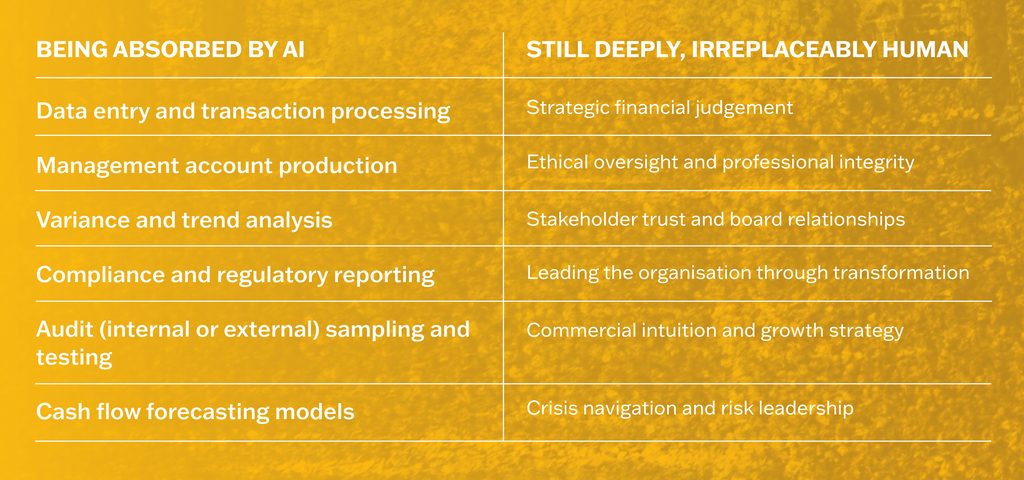
The left-hand column is no longer a task for the CFO or, indeed, their teams. It is their responsibility but not necessarily their task…
The process should not consume the CFO’s time and attention. AI will do it faster, with fewer errors, and at a fraction of the cost.
The right-hand column is where your CFO must live. And it is the right-hand column your recruitment process needs to stress-test.
What are the Seven Skills your CFO Must Have?
Think of these as core requirements rather than soft skills or nice-to-haves. They will will determine whether your finance function is a competitive advantage or a back-office cost centre in the years ahead.
1. The Courage to Tell the Truth
This sounds obvious, but it is harder than it seems.
The CFO must be the person in the room who will say what others will not. Who will challenge the CEO’s optimism with evidence. Who will tell the Board that the acquisition looks great on a slide and catastrophic on a cash flow. Who will stand behind an uncomfortable number and defend it, not because it is popular, but because it is right.
In an AI-rich environment, where data is abundant and interpretation is contested, this quality becomes more critical, not less. Anyone can generate a report. Not everyone can walk into a board meeting, stand behind it, and say ‘here is what this actually means for our strategy.’

2. Strategic thinking that goes beyond finance
Your CFO must understand the business – basic, I know!
They need to know your customers, your market dynamics, your competitive pressures, and your operational constraints. Financial strategy that is disconnected from commercial reality is arithmetic, not strategy.
The best CFOs we see today are those ingrained with the COO, the CEO, the CTO, and the CPO – none of them should operate in a silo or without cross responsibilities.
AI will give your CFO and the rest of the C-suite better data than ever before. The question is whether they have the commercial instinct to know what questions to ask of it.
3. Leadership through transformation
History is instructive here. Time and again, through the advent of computers, ERPs, global communication platforms, and now AI, it has been the finance leader who has been asked to anchor major organisational change.
Why? Because good finance leaders are trained to navigate uncertainty. They are comfortable with risk quantification. They can hold the competing tensions of short-term cost and long-term investment. They understand how change ripples through an organisation’s financial model.
Your next CFO will almost certainly be asked to lead your AI transformation agenda or at minimum, to co-own it with the CEO. Do they have the change leadership capability to do that? Have they done it before?
What to look for:
More than just finance transformation experience. Look for evidence of leading cross-functional change. The CFO who has only ever managed a finance team is underprepared for what is coming.
4. Ethical clarity and governance instinct
Chartered Accountants are ranked among the most trusted professionals in the world. That trust is the product of a qualification that drills ethical reasoning, professional scepticism, and objectivity into its practitioners from day one.
In an AI-driven world, this matters more than it ever has. AI systems can be wrong. They can be biased. They can produce outputs that look authoritative and are quietly, dangerously flawed. Your CFO must be the person who knows this, who builds the governance frameworks, who demands the human oversight, who refuses to let automated outputs be accepted without interrogation.
The Board needs a CFO who will govern AI as well as use it, and who will ask the hard questions about where the data came from, what assumptions are baked in, and whether the output can actually be trusted.

5. Communication that moves people, not just informs them
Financial information is only valuable if it changes behaviour. A CFO who can produce a brilliant analysis but cannot communicate it in a way that lands with the Board, the CEO, investors, and the wider team is not delivering their full value.
This is about translating complexity, rather than simplifying it. The ability to take a sophisticated financial picture and present it in a way that drives action – that is a skill. And it is one that AI cannot replicate, because communication is relational. It requires reading the room, adjusting in real time, and building trust through presence.
Your CFO will increasingly be a public face of the business — to investors, to regulators, to partners, to employees. Hire someone who commands a room.
6. High emotional intelligence
The finance function has long struggled with a reputation, fair or not, for being process-driven and people-light. The CFO of tomorrow cannot afford that reputation.
As the routine tasks are absorbed by AI, the finance leader’s time will be spent increasingly in human interactions — negotiating with investors, advising the CEO, managing a team whose roles are changing, and building relationships with stakeholders who need to trust the numbers they are being given.
Emotional intelligence (the capacity for empathy, self-awareness, and relational fluency) is not a soft skill. It is the infrastructure of influence. Influence is what a CFO needs to actually change the direction of a business.

7. Technological fluency
There is a difference between a CFO who says ‘we are exploring AI’ and one who can tell you precisely which processes in their function have been automated, what the governance framework looks like, what the risk register contains, and what the measurable impact has been.
You need the latter.
This does not mean your CFO needs to be a technologist. But they must be a sophisticated consumer and commissioner of technology. They need to understand enough to ask vendors the right questions, hold IT and data teams to account, and make technology investment decisions grounded in commercial and strategic reality.
What to stop hiring for
This is the part that makes Boards uncomfortable. Because it requires letting go of some of the signals that have historically felt like proxies for quality.
• Stop over-indexing on the technical accounting qualification alone. It is necessary but not sufficient. A first-class accountant who cannot lead, communicate, or think strategically is the wrong CFO for this moment.
• Stop treating the number of years in a finance role as the primary indicator of readiness. The CFO who has spent fifteen years perfecting the month-end close process may be deeply unprepared for what is actually needed.
• Stop hiring in your own image. If your Board has always had a certain type of CFO, ask honestly whether that type is the right fit for the next five years or just the last twenty.
• Stop allowing the recruitment brief to be written by the finance function alone. The CEO and the Board should own this hire. It is too important to delegate.
A Final Word to Boards
The CFO is not a support function. They are not back office. In the AI era, the finance leader, if you hire the right one, becomes one of your most powerful strategic assets. The person who can take the flood of data that AI produces, apply human judgement, ethical rigour, and commercial intelligence to it, and help you navigate what comes next.
That only happens if you hire for it.
The profession is changing. The skills required are shifting. The old brief no longer produces the right result.

You get to decide which one you hire.
Summary: The CFO skills checklist for Boards
When evaluating your next CFO, whether through recruitment or appraisal, assess rigorously against these seven capabilities:
• Courage to deliver uncomfortable financial truths to the CEO and Board
• Strategic thinking that extends beyond the finance function into the commercial heart of the business
• Proven track record of leading organisational transformation
• Ethical clarity, professional scepticism, and the instinct to govern AI-generated outputs
• Communication ability that moves stakeholders to action — not just informs them
• High emotional intelligence and the relational skills to build trust at every level
• Technological fluency — able to interrogate, commission, and govern AI tools in the finance function
These are not the skills of a traditional CFO. They are the skills of the CFO your business needs now.
Sinead Donovan FCA is Strategic Board Advisor at Barden, former Chairperson of Grant Thornton Ireland, and Past President of Chartered Accountants Ireland.”