


If three people on your team qualified the same lead tomorrow, would they reach the same answer, for the same reasons? In my own business, the honest answer was no. In this second piece of our AI Applied series with Barden, the case study is a little closer to home: how we fixed our own sales pipeline at Park Lane.
The Problem
A typical week for me meant arranging meetings and following up with clients and potential clients, each of them at a different stage. We started off with a spreadsheet, which is the reality of life for most small businesses, and of course we were not updating it. So we moved to a leading CRM system.
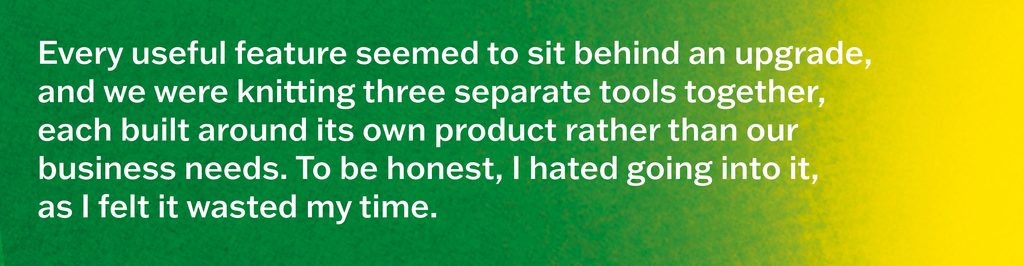
I wanted simple answers. What is in the pipeline, how big are the deals, and how likely are they to close? We are all concerned with future cash flow, after all. Instead, I found myself going down a rabbit hole of features and upgrade paths, giving up for a month, and then coming back to the same frustration. I was trying to fix the CRM software instead of my clients’ needs.
The bigger issue was consistency. There are a few of us selling, and each lead was qualified however its owner saw fit. We were also all guilty of being overly optimistic, which I think is human nature. You come off a call feeling like you had a really good conversation, but you still do not know who the economic buyer is, and you have not quantified their pain point.
Our pipeline highlighted the problem. Deals were not closing and clients were sitting on proposals, because we were not asking the right questions at the right time. It did not help that, like many founders, I was relatively new to running a sales process.
The Solution
The turning point was realising how simple this could be. I was reading a couple of books on sales, and it struck me that for a small business like ours, it is fairly straightforward. We needed a framework, plus honesty and clarity in the conversations we were having.
The picture in my head was the classic sales funnel, nothing magic, with a stage gate and a set of honest questions at each stage. If you know where every opportunity sits in that funnel, it will project your outcomes. So we built our own process around a recognised, proven qualification framework and around how we provide value to clients.
The process now works in three steps:
- When a new lead comes in, an enrichment tool researches the company automatically, finding out who the CEO and CFO are, how big the organisation is, and what technology it uses, and then proposes an engagement strategy.
- AI layers that research on top of what we know about our own business, including our strategy, ideal customer profile, financials, pricing, and previously won work. It then tells me where I am in the process and what I still need to find out, for example, the client’s decision criteria for the solution.
- I add a few short notes, and our Sales Manager Agent assesses where each opportunity really stands and prompts me to follow up at the right time.
It also looks at the work we have won and why we won it, then goes out to find lookalike companies for me to contact. What it does not do is get the meeting in the diary. People still buy from people, and nothing reaches a prospect without one of us approving it.

It has a framework, coaches me to have the right conversations at the right time, and has no bias, ego, or quarterly projection to ‘massage’. Everybody would love a manager who is totally honest and direct, without any agenda, and that is exactly what our Sales Manager Agent is.
The Challenges
There were fewer growing pains than I expected, though there is always a feature or two you have not quite thought through. Three things mattered most: keeping it simple, connecting the tools, and keeping people in control.
Simplicity. The temptation is to keep adding features, which is exactly what put me off the old system. Ours is not a feature-rich tool. Its foundation is the knowledge of our business: the services we offer, how we classify each client, where they are, and what the focus should be. That is enough.
Connecting the tools. With the old set-up, every tool we added had to be fitted to the next one’s way of doing things. Now the specialist tools plug in only where they earn their place, and they serve the process rather than shape it.
People in control. The AI researches, prompts, and coaches, and the decisions stay with us. That matters all the more when you are dealing with clients, because trust is built person to person.
Every business is different, with its own customer profiles and target market, so the questions will change from one to the next. Another client in a completely different industry has just started using the same process, and I am keen to see the results they achieve.
The Result
Sales is not linear, so the result is harder to pin to a single number than it was with the cash forecast. The clearest change is in how we work. I used to hate going into our old CRM, and now I love using this one, maybe because it came out of my own head.

The clunkiness of our old CRM software meant we did not have the discipline or motivation to use it. Now we do, and it is already showing. Last week, our new process helped me focus on the right questions to build urgency with a client, and they closed this week. I have two other clients from before we built it who are still sitting on proposals, and I cannot help wondering whether coaching from our Sales Manager Agent at the right stage would have moved them on.
There was also a benefit I did not plan for. Sales runs on the same base as the rest of the business, so a piece of work we win flows straight into our cash flow projection, and on into billing and delivery. Businesses are connected, organic things, and sales and delivery should never really have been separate.
Takeaway
Take your last five closed deals, won and lost, and write down why each one went the way it did. If your team would give five different answers, that is the first thing to capture. From there, decide which questions need answering at each stage of your funnel, and make sure they are asked the same way every time, whoever owns the lead.
If you would like to talk through a process in your own business, I would be glad to hear from you. You can reach me at ronan@parklanehq.com, and I am always happy to meet for a coffee.
Ronan Rooney is Co-founder and Director of Park Lane, an AI transformation firm, and its platform company Oak & Nine (see here>>>)