


Ireland’s software development market continues to evolve, with businesses increasingly prioritising engineers who combine strong technical foundations, adaptability and the ability to work effectively with modern engineering tools.
As technology landscapes become more complex, software engineers are operating across a broader range of disciplines – from application development and cloud infrastructure through to automation, security and AI-enabled solutions.
Based on our conversations with hiring managers and talent, we’ve identified some trends shaping the market.
First, let’s look at the changing balance of activities across the software development continuum.
#1 Software Development Continuum of Activity
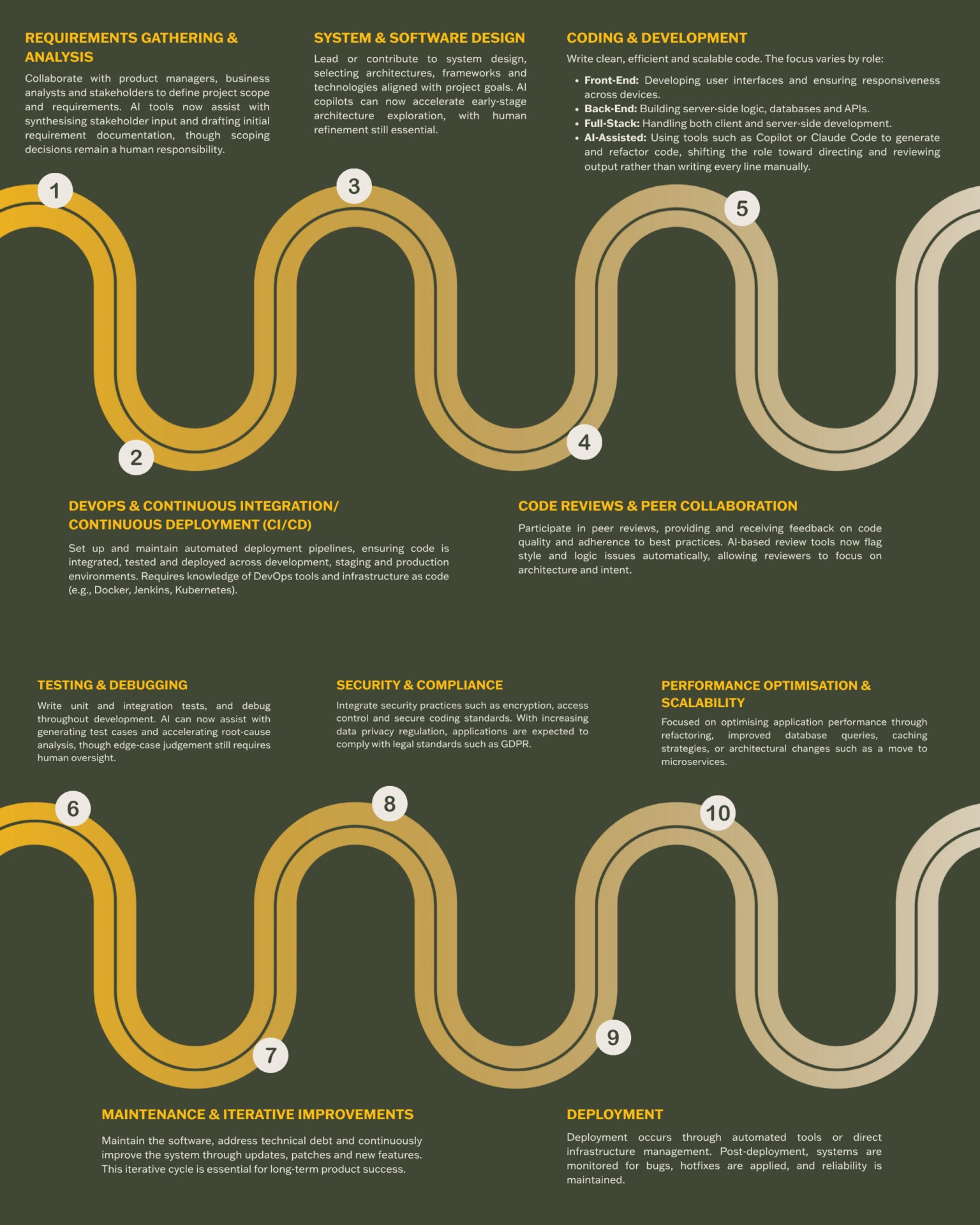
Software development roles have expanded significantly in recent years. Engineers are increasingly expected to work across a wider technology landscape, with responsibilities spanning software development, cloud infrastructure, security, AI engineering, data, automation and systems architecture.
AI capabilities are now influencing multiple stages of the software development lifecycle, from requirements analysis and system design through to development, testing, deployment and optimisation. As a result, the role of the modern software engineer continues to broaden beyond traditional coding responsibilities.
#2 Salary Insights: Software Development in 2026
Hiring has become increasingly targeted. While demand remains strong for experienced engineers with specialised skills, companies are placing greater emphasis on technical depth, domain expertise and the ability to deliver effectively using modern engineering practices.
Salary levels vary depending on factors such as company size*, industry, location**, technical expertise and leadership experience. The following salary ranges are general guidelines; actual compensation will vary based on individual circumstances.
*Larger multinational technology companies often offer base salaries circa 20% above the wider market, alongside restricted stock units (RSUs) that can significantly increase total compensation.
**Salaries also vary by region, with Dublin typically offering compensation around 15–20% higher than other regions.
#3 AI in Software Engineering
AI is moving beyond experimentation and becoming a practical capability within software engineering teams. The strongest organisations are not simply adopting AI tools – they are evaluating where AI can improve engineering workflows, enhance products and support better technical decision-making.
For engineers, the expectation is increasingly shifting from awareness of AI tools to the ability to apply them effectively in real-world environments.
What to Look For
The strongest signals of AI-capable engineering talent include:
- Experience integrating AI capabilities into production applications, APIs and platforms.
- Hands-on understanding of AI application patterns, including retrieval-augmented generation (RAG), agentic workflows and model integration approaches.
- Ability to evaluate AI solutions against engineering considerations such as reliability, scalability, cost and performance.
- Experience using AI-assisted engineering tools effectively while maintaining strong coding standards and software quality.
- Understanding of data quality, governance and security considerations when developing AI-powered applications.
A key shift in 2026 is that AI capability is becoming part of the broader engineering skillset rather than a separate specialist area.
While many engineers are experimenting with AI tools, production-level AI experience remains relatively limited. Engineers who can demonstrate experience delivering reliable AI solutions within enterprise environments are in very high demand.
#4 Current Snapshot of the Software Development Talent Pool



Here’s what we’ve noticed this quarter in the Software Development talent pool in Ireland:
- Full stack engineers remain highly sought after, particularly those with experience across cloud, architecture, scalability and complex systems.
- AI experience is increasingly becoming a differentiator, but hands-on production experience remains relatively scarce.
- People who demonstrate curiosity, continuous learning and the ability to adopt new technologies effectively are standing out in the market.
- Companies continue to prioritise engineers who demonstrate ownership, problem-solving ability and the ability to work across technical domains.
- Junior hiring continues to evolve as organisations assess how AI tools influence productivity, team structures and the skills required from early-career developers.
#5 Other Trends for 2026
While AI is influencing the software development landscape, other technical areas continue to shape how organisations build, deploy and maintain software.
Cloud & DevOps
Cloud platforms and DevOps practices remain foundational to modern engineering teams, with increasing focus on building scalable, automated and reliable environments.
Engineers with experience across the following areas continue to be in high demand:
- Cloud architecture and infrastructure design.
- Platform engineering and internal developer platforms.
- Infrastructure-as-Code and automation.
- Kubernetes, observability and deployment practices.
- The infrastructure requirements needed to support increasingly complex applications, including AI workloads.
Security
Security is now a fundamental requirement throughout the software development lifecycle.
Developers are expected to consider security from initial design through to deployment and ongoing maintenance. Growing awareness around GDPR, data protection and increasingly sophisticated cyber threats means secure engineering practices are becoming a core expectation.
The adoption of AI also introduces additional considerations, including data privacy, model security, access control and governance. Engineers who understand both application security and emerging AI security principles will continue to be highly valued.
#6 What This Means for Hiring Managers
The software engineering market is becoming increasingly skills-driven. While strong technical foundations remain essential, organisations need engineers who can adapt, learn continuously and operate effectively within rapidly changing technology environments.
For hiring managers, this means:
- Hire for capability, not just technology experience – look beyond specific tools or AI keywords and assess problem-solving ability, adaptability and strong engineering fundamentals. While production experience with AI-enabled solutions is increasingly valuable, consider the level of AI maturity your team requires and whether there is scope to hire engineers with strong foundations who can develop these capabilities over time.
- Invest in your engineering environment – access to modern tooling, strong technical cultures, learning opportunities and flxexible working models remain important factors in attracting and retaining talent.
- Review how teams evolve – AI will continue to influence workflows, roles and productivity, making ongoing learning and adaptability increasingly important.
In Barden, we understand that each team, role, and requirement is unique. If you would like to discuss what tactics and approaches would suit you, please feel free to contact Rachel McGuckian, our Software Development Talent Advisor & Recruiter here in Barden (rachel.mcguckian@barden.ie); we’re where leaders go before they start looking for Software Development talent.
This information is accurate as per October 2026 and will be updated periodically. Data sources include Barden Proprietary Data, LinkedIn Analytics and other 3rd party data sources. If you have a request and would like real-time information to inform your hiring decisions, contact Rachel McGuckian at rachel.mcguckian@barden.ie.