


As organisations enter 2026, the pace and breadth of change continue to accelerate. Businesses are delivering multiple, concurrent programmes spanning technology, regulation, operating model redesign and cultural change, often with limited capacity and increasing focus on outcomes.
In this environment, Project and Change professionals act as critical enablers of strategy execution. Their value is increasingly measured not only by on-time, on-budget delivery, but by outcomes including adoption, value realisation and long-term sustainability. Project & change management is often inconspicuous, as its success lies in the absence of problems, cost overruns, time delays and deferred project or program delivery.
In Barden, we partner with organisations navigating complex and competing transformation priorities. The insights below outline the key considerations for employers hiring Project and Change talent.
#1 Project and Change – verticals
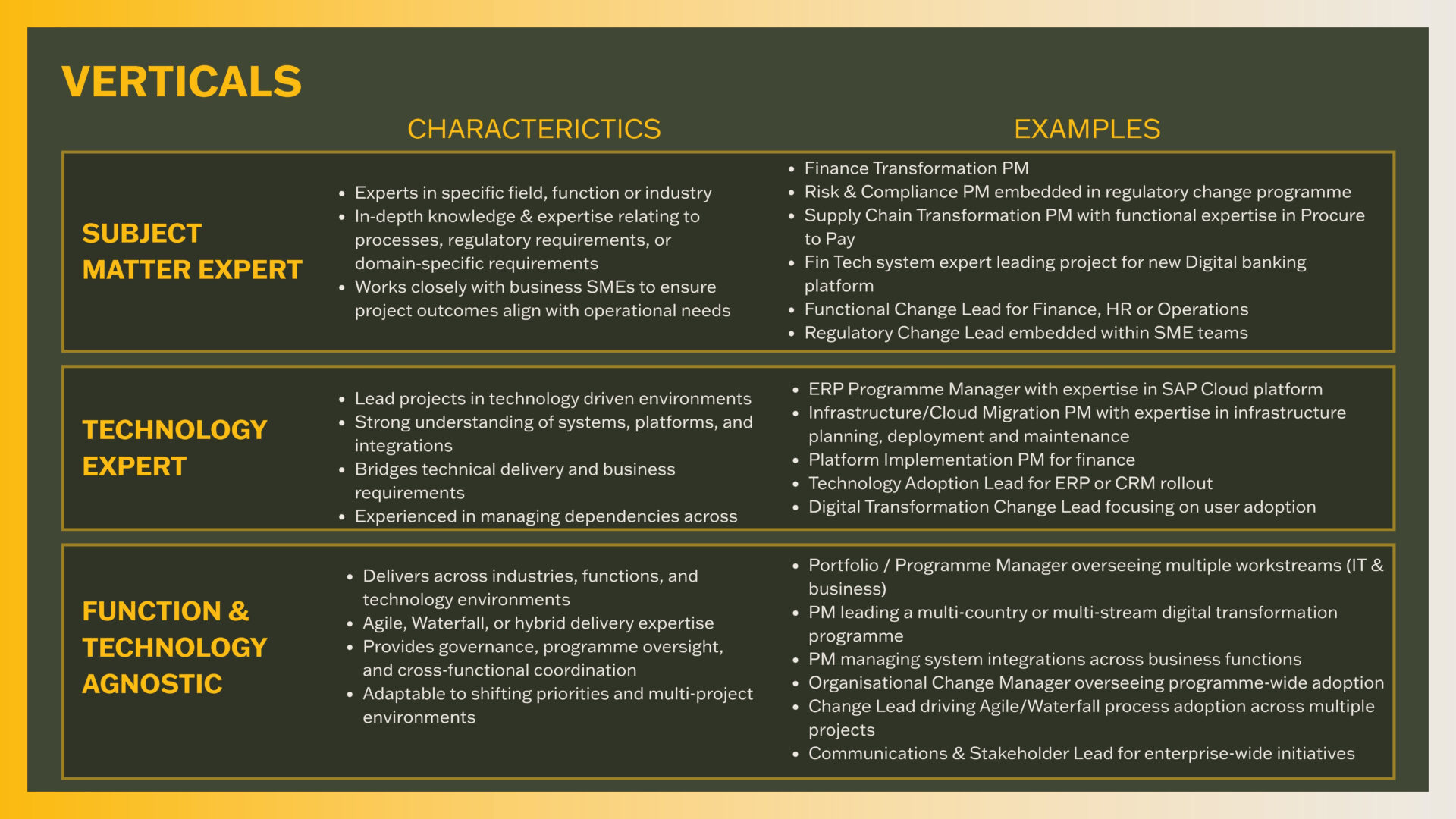
In Barden we categorise Project and Change professionals across 3 verticals as follows:
- Subject Matter Expert
- Technology Expert
- Function & Technology Agnostic
These verticals provide a practical way for both organisations and professionals to clearly define capability, experience and value. Understanding the primary vertical required is critical when shaping a role, building a project team or assessing the impact an individual is best positioned to deliver. In practice, many transformation initiatives require a blend of these verticals working together. For example, in an Enterprise Resource Planning (ERP) programme, a technology-focused Project Manager with deep ERP delivery experience will typically work alongside Subject Matter Experts across areas such as Record to Report, Order to Cash, and Finance & Controlling. In addition to being supported by function-agnostic delivery leadership to ensure overall governance and momentum.
The verticals definition also enables Project and Change professionals to better articulate their own profile; defining their strengths as they relate to, for example, deep functional knowledge (SME), technical delivery expertise (Technology Expert) or broad programme leadership (Function & Technology Agnostic) across diverse environments.
Let’s explore the verticals in more detail including typical characteristics and examples.
#2 Base/Salary Considerations
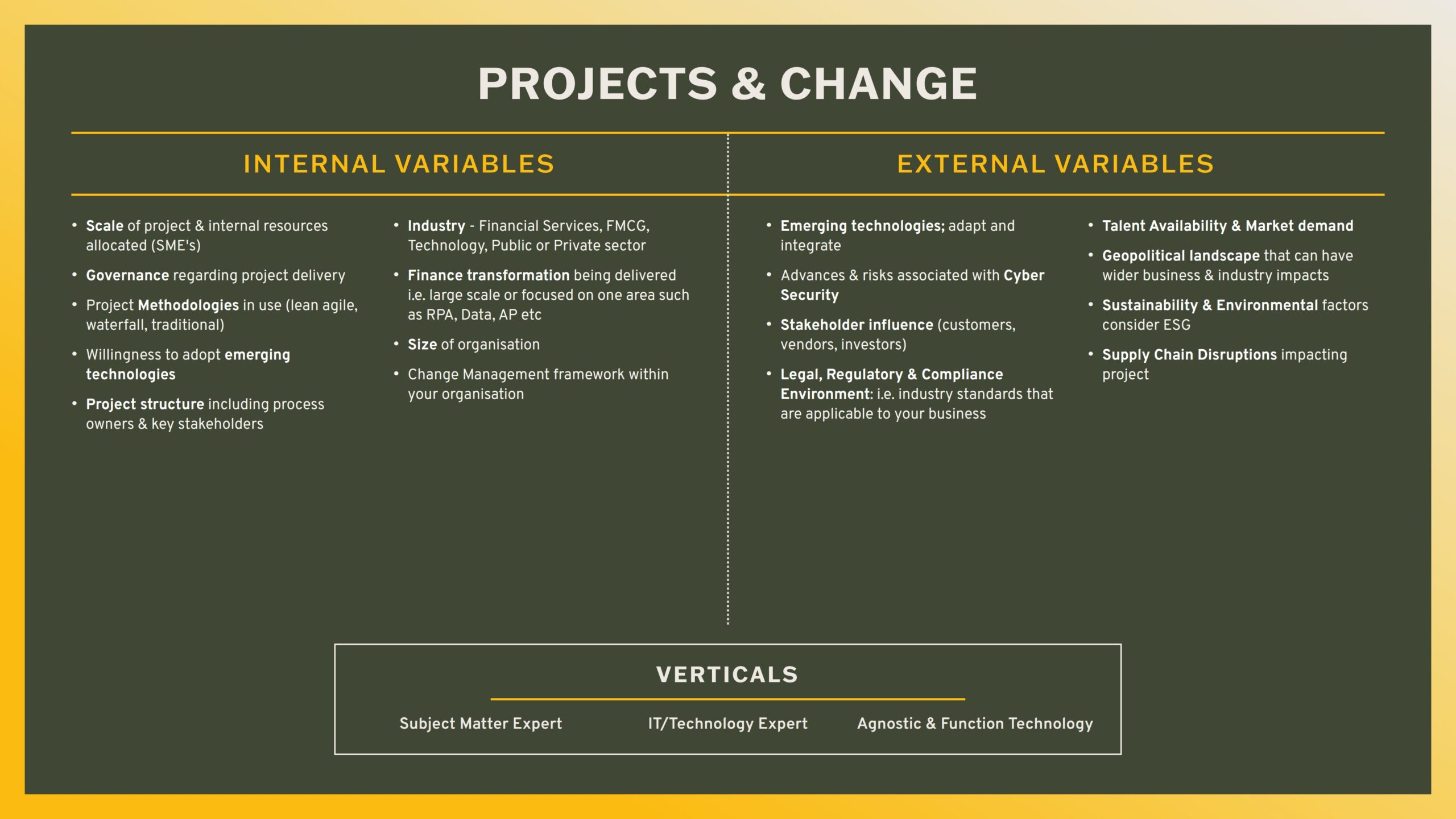
The variables that are relevant to the role you are hiring for are critical in determining both the base salary and overall remuneration package. While bespoke benchmarking remains essential, the following factors are particularly influential:
- Technology or SME expertise: A project requiring specialised skills in areas such as regulatory change, system and technology or specific industry expertise can contribute to higher salaries.
- Project Complexity & scope: Compensation is often linked to the scale, strategic impact, and intricacy of projects. For example, professionals leading multi-stream, cross-functional programmes with regulatory or technology components can expect to command higher salary levels.
- Industry and Sector: Project and change professionals in sectors such as Finance, FinTech, Financial Services, or Technology can attract higher salaries due to sector-specific challenges and expertise required.
- Market Demand & talent availability: Supply and demand dynamics for project management and change professionals in a particular region or industry can influence salaries and may lead to increased compensation.
- Location: Geographic location is an important consideration. For example, you can expect a 10-15% reduction on salary scale when considering appointments outside of Leinster.
The following provides a broad guideline of salaries covering multiple verticals and industries.
For bespoke advice please contact our team; catherine.drysdale@barden.ie (Leinster) or christine.mccarthy@barden.ie (Munster).
#3 Talent Availability
Here are some data points about the Project and Change talent pool in Ireland this quarter:




#4 Key considerations for the next 12 months
The Project & Change Office within any organisation will continue to play a vital role, especially in the context of the heightened focus on regulatory programmes and business transformation. Staying agile and forward-thinking will be critical for professionals in this space.
Some key considerations for the year ahead:
- Regulatory-driven transformation as a dominant demand driver: The broader Regulatory change agenda remains a key driver of transformation activity. Initiatives stemming from DORA, CSRD, SOX/IT controls, data localisation, and other sector-specific regulations are creating complex, multi-year programmes that organisations cannot delay. This is driving demand for Project and Change professionals who can operate at the intersection of compliance, technology and business operations and delivering projects under strict regulatory timelines.
- Resilience & flexibility in transformation strategies: Uncertainty is the new constant – this is our new norm! Resilience planning is paramount in the face of geopolitical tensions and climate-related disruptions. Project and Change talent will need to continue to focus on agile transformation strategies to ensure business continuity while navigating unexpected challenges.
- AI Capability and the trust gap: As AI becomes increasingly embedded in business processes; trust and understanding of its capabilities are still evolving. Project and Change professionals are required to balance what AI can do with what stakeholders trust it to do, ensuring ethical, transparent, and explainable implementation across programmes. Building this trust remains critical to driving adoption and achieving the intended business impact.
- Competing for and retaining top talent: With transformation capability in high demand across all industries, your companies value proposition (such as employer branding, structured career progression & development, benefits package) remain key factors to ensure you retain and attract the best talent on the market. Addressing any known gaps in your team through strategic upskilling and targeted talent development is essential to stay competitive.
In Barden, we understand that each team, role, and requirement is unique. If you would like to discuss what tactics and approaches that would suit you, please feel free to contact Catherine Drysdale (Leinster) or Christine McCarthy (Munster) our Project and Change Talent Advisory & Recruitment team here in Barden (catherine.drysdale@barden.ie; christine.mccarthy@barden.ie). we’re where leaders go before they start looking for Project and Change talent.
This information is accurate as per October 2026 and will be updated periodically. Data sources include Barden Proprietary Data, LinkedIn Analytics and other 3rd party data sources. If you have a request and would like real-time information to inform your hiring decisions contact Catherine Drysdale at catherine.drysdale@barden.ie or Christine McCarthy at christine.mccarthy@barden.ie.