

These days there is no doubt that leading a team and having superb emotional intelligence (EI) go hand in hand. But what exactly is it and why should we embrace high levels of EI as leaders?
To help us out with this one we asked John Slattery from our Partner Firm INSPO. Here John explains what it is and some key pieces that will help you.
Defining Emotional Intelligence
It was helpful when we chose this topic to know that I had Daniel Goleman’s book on Emotional Intelligence to draw on at home.
However, what was needed first was a definition. Having looked through the Google search results for emotional intelligence it was the definition of the Institute for Health and Human Potential that stood out. It described Emotional Intelligence as the ability to:
- Recognise, understand and manage our own emotions.
- Recognise, understand and influence the emotions of others.
When I looked at the back of Daniel Goleman’s book, three terms jumped off the page as being key to bring that definition of emotional intelligence to life:
Self-Awareness
Our ability to be aware of our own emotions, biases and thoughts is absolutely key in demonstrating emotional intelligence. This awareness of our own state allows us to determine what of these emotions, biases, and or thoughts are helpful in a given moment.
A great mindfulness teacher I know often would say that a key question to ask ourselves is, ‘what is going on for you that is causing you to react a certain (especially when negative) way to someone else’s behaviour?’. The more we know about ourselves the more we are able to best manage ourselves in different situations.
Self-Discipline
Have you ever watched a David Attenborough nature programme and observed a gazelle bolt at the possibility of a predator being close by? The reaction is so instantaneous. We are capable of such reactions at such speed in human interactions. It requires an absolute discipline to not succumb to that oh so primitive, internal and protective call to react – especially where that reaction may be an adverse one. This aspect of emotional intelligence is so key to maintaining good conversations and good relationships within a team.
Empathy
The phrase ‘putting yourself in someone else’s shoes’ is a phrase often used. In the modern world it’s a difficult skill to master. Why? Because in the modern world it’s harder to listen than ever. Distractions are everywhere. Plus, we can often listen with our own story, with how what is being said impacts us, in mind.
Empathy comes from truly listening. From trying to really hear and understand what the person is saying and what it means for them. It also comes from demonstrating that you genuinely understand what they are saying and the feelings, emotions and thoughts that go with it.
These three traits are key to demonstrating emotional intelligence.
Why should we, as leaders, want high levels of emotional intelligence?
I’m reminded by something Louise Phelan, formerly of tech payments company Paypal, said at a talk a few years back. She said despite the growing importance of technology in the world, people buy people.
The greatest currency in the world is still the relationships that exist between people. In terms of getting the best from your team your ability to do so is dependant on you having great interactions and relationships across the team. Emotional intelligence is a brilliant enabler of this.
It will help you fortify the relationships you have with your team; and it will enhance the communication between you and your team.
It will make daily life within the team better, easier and more productive.
It is most definitely worth investing in.
Want More Insights and Support in Leading Your Teams?
Barden and Inspo have a common drive. Barden helps companies build great teams and Inspo helps teams to be great, together. Simple.
If you’d like to hear more about this work feel free to contact Ed Heffernan in Barden, or John Slattery in INSPO.
Read about Barden and INSPO’s partnership here.
For more great insights on leading your team visit our blog section here.
Work-life balance can have enormous value in any organisation but meeting the needs of a broad spectrum of employees is more art than science. In a recent edition of Accountancy Ireland Ed Heffernan, Managing Partner with Barden, delves into what does work-life balance actually mean…
A Major Part of the Conversation
For well over a decade now, work-life balance has been part of the conversation. The 2019 Chartered Accountants Ireland Leinster Society Salary Survey, in partnership with Barden, cited, perhaps unsurprisingly, that 86% of respondents said it was a key factor when considering an external move. Surprisingly, however, some 52% of respondents cited they would sacrifice up to 10% of their financial reward for better work-life balance.
Furthermore…
- 82% of Leinster Society Salary Survey 2019 respondents said work-life balance is as an important factor in considering an external move as their pay packet.
- 86% of Leinster Society Salary Survey 2019 respondents place a strong value on work-life balance and flexible working arrangement.
What is this mysterious, evasive thing that the majority of accountants would take a pay cut for? How is work-life balance defined? Sometimes things are more easily defined by what they are not, rather than what they are.
Here’s an example:
- Work-life balance does not mean equality between work hours and non-work hours;
- Work-life balance does not necessarily mean working fewer hours than you are working now;
- Work-life balance is not a one-size fits-all matter; it means different things to different people and will have a varied meaning over time foreach individual; and
- Work-life balance means different things to different generations; for some, it’s a nice-to-have while for others, it’s an expectation.
Flexibility, Achievement & Enjoyment
More often than not, work-life balance comes down to three things – flexibility, achievement and enjoyment.
Flexibility is doing your job at the times that work for you. We all have different commutes and different responsibilities outside of work; the employers that recognise this as a fact of life are the ones who retain their people for longer and get more return for their people’s time.
For example, some employers will:
- Allow some degree of flexibility on start and finish times to allow for commutes, family responsibilities, sports commitments or even to make sure that when someone needs to finish a little early, they feel that they can;
- Allow people to work from “not the office” and trust that they will. Numerous studies suggest that the worst possible place for employee productivity is the workplace – there are just too many distractions. Enabling certain types of work, especially the type of work that requires uninterrupted focused activity, to be conducted outside of the office can lead to substantial increases in productivity; and
- Giving a little can mean gaining a lot. If one of your team has a medical appointment or another one-off event, allowing them the freedom to be away from the desk without deducting the time from their holidays, or stating that they have to make the time up, can have enormous reciprocal effects in the future. Small, random acts of kindness are more powerful than any policy.
There is a catch, though. Even if a company does manage to create a flexible working environment, it is still not going to please all of the people all of the time. When it comes to flexibility, some people at certain stages in their life will need a little more; others a little less. Implicit to the flexibility component of work-life balance is that it means different things to different people at different stages. Companies that create a culture of flexibility as opposed to enforcement often get the best results.
Achievement is the cornerstone of human ambition. Everyone needs to have a clear understanding of what they need to achieve in their role and to be recognised when this achievement occurs. This can be weekly, monthly or even annually. It must be measurable in some way and it must be recognised, either intrinsically (for example, a simple ‘thank you’ for a job well done) or extrinsically (for example, some type of financial reward – a token, an unexpected gesture, a bonus, or even a salary increase). Everyone needs to feel that they are achieving something in their role, and it is ultimately up to their direct manager to ensure that achievements are recognised. Those who feel they are achieving something tend to feel like they have work-life balance and in many cases, they feel this way regardless of the hours they work.
Enjoyment is a less tangible, but equally important, part of work-life balance. Enjoyment does not just mean having fun – that’s only part of it. Enjoyment has a much wider definition when it comes to work-life balance. It’s how you feel about what you do; it’s how it feels to work in your team; it’s feeling that you are working towards a shared goal; it’s respecting and learning from the people you work with; it’s celebrating success and learning from failure with your colleagues; it’s the opportunity to help others learn; it’s the opportunity to work in a business that you believe in for a cause you admire; and it’s a whole lot more. Flexibility and achievement are the easy ones to define and create a policy for – enjoyment is the piece that is really personal, and the piece that many managers often get wrong.
Work-life balance can have enormous value in any organisation. Get the mix of flexibility, achievement and enjoyment right, and your people will work harder, be happier, be more productive and will stay longer. Get it wrong these days, and you will end up with the opposite. It’s that easy.
Why Authentic Leaders Listen
For some people, it isn’t the work component that creates the imbalance; it’s the life component. At certain times, we all come under stresses that have nothing to do with work. Some people make work the escape from these stresses; other people bring these life stresses into the workplace with sometimes devastating consequences.
People don’t change without reason. If someone on your team begins to submit work that isn’t up to their usual standard, uncharacteristically misses multiple deadlines or just seems ‘off form’ in the office, don’t get annoyed – get curious.
Sometimes it might just be listening; sometimes it might be arranging some extra flexibility or a reduced workload on a temporary basis. Regardless of the situation, every time you engage and, where you can, offer to take action, you will not only make a difference for that person, but you will create longer lasting, deeper bonds between yourself and your team. You can create the space your people need when life causes an imbalance. And from experience, that’s where the real magic happens.
It’s easy to ignore the problem, but it takes bravery to ask the question. Which type of leader are you?
Source: Accountancy Ireland October 2019
Making sure you have the right information, resources and tools to hand when planning and implementing your recruitment activity is vital.
“Right now we are in an increasingly unique market – where demand for accounting talent has reached a peak never before seen. From recently qualified, to about 7 years PQE, there is more opportunity now for people than ever before. It’s really good news for accounting professionals, but it does mean that many leaders and hiring managers are having to rethink how they are attracting talent, and especially the cream of the crop.” – Elaine Brady | Managing Partner | Barden Dublin
Recruiting great people isn’t rocket science but trying to do so without the latest insights on salaries, benefits and what’s important to those looking for new opportunities could be classed as madness!
To make sure you’re armed and ready to attract, and retain, the cream of the crop check out the Chartered Accountants Ireland Leinster Society Salary Survey, in partnership with Barden.
The 2019 Salary Survey results are sure to help you in building your world class accounting and finance teams.
Need help building your finance teams?
Barden is the largest expert accounting and tax recruitment practice in Leinster. If you’re a finance professional seeking opportunities ,or a leader looking to attract new accounting or tax talent, speak to our experts today at hello@barden.ie.
We’re essentially at full employment in Ireland, and it’s bursting at the seams. So how do you as an employer stand out from the crowd, attract the cream of the crop and win the ‘War for Talent’?
Having the Right Tools in Your Tool Kit
The 2019 Chartered Accountants Ireland Leinster Society and Barden Accounting & Tax Salary Survey brings you the most up to date insights on reward.
“As experts in our field, it’s absolutely critical for us to be able to provide our clients with cutting edge insights on reward so that they, in turn, can make informed strategic decisions on talent attraction and retention, and essentially win the ‘War for Talent’. The insights gained in this year’s Salary Survey enable us, and you, to do just that.” Elaine Brady | Managing Partner | Barden Accounting & Tax
Given that reward has gone from being part of the conversation, to THE conversation, this is an essential piece of reading for you to have in your tool kit for winning the ‘war for talent’.
But Here’s the Interesting Thing About Reward…
Reward is no longer just about pay.
Accountants today EXPECT to be paid well. They’re smart, hardworking and have trained hard to become qualified.
Increasingly, as extrinsic reward levels become expected, it is intrinsic reward that is becoming the defining factor in people’s career decisions.
Intrinsic Reward
A substantially more complex concept…it’s essentially everything you can’t put a monetary value on.
And more importantly, according to the results of the 2019 Salary Survey, it’s a lot about work life balance and flexibility.
For the first time ever the results found that work life balance & flexibility are now AS important for people as the salary they will secure.
· 82% of respondents said it’s as important a factor in considering an external move as their pay packet.
· 86% place a strong value on work life balance and flexible working arrangements.
· 52% would sacrifice 10% of remuneration for better work life balance flexible working arrangements.
Yet Most Companies Aren’t Offering It
With a staggering 40% of respondents having no access to working from home, or a flexible benefits policy, it’s clear that most companies aren’t offering proper work life balance or flexibility.
Madness? Maybe, but it’s also an opportunity for you and your company.
It’s important to note that work life balance is not about working less. It’s about working the same amount but at times that suit your life better.
Offering proper work life balance and flexibility is a way for your company to watch their bottom line, have more satisfied employees and essentially win the ‘war for talent’.
Simple.
So are we! Kate Flanagan, Partner and expert in tax careers with Barden Dublin, recently attended the Global Tax Conference, which took place in Dublin.
Taking place over 3 days the event, organised by the Irish Tax Institute and Harvard Kennedy School, brought together the best minds in global tax from over 30 countries.
Here Kate takes you through the key insights you need to know about the impact of global tax reform on the tax employment market in Ireland.
An optimistic future
Having attended the recent Global Tax Conference at Dublin castle, myself and my colleague Aideen Murphy (Partner and expert in tax careers with Barden Cork) came away with great insights into the future of the tax profession in Ireland, and most importantly a lot of optimism!
Global tax reform, tax in a digitalised economy and the future of tax were all topics discussed. Whilst we won’t attempt to analyse the technical matters of such topics, we have identified a couple of areas which may impact the employment opportunities and skills required right now, and in the future for tax professionals in Ireland.
The future of the tax profession – 30% of workers in tax will be out of work!
Mike Williams, HM Treasury, boldly stated “30% of workers in tax will be out of work in 10 years as a result of technology, specifically data”. He explained reform will be driven by technology and the day will come where will be no tax returns & no tax administrators.
Thankfully Jeffrey Owens, Director, Global Tax Policy Center disagreed on that point. He agreed technology will of course impact the tax function of the future, but explained that as tax is such a complex matter, and as transactions will be more complex and broader (even in terms of geographical reach), there will be an even greater demand for tax professionals. Good news!
The other point raised to support the future of the tax profession was around transparency. Within the last 10 years, especially post financial crisis, there has been, and will continue to be a huge focus on transparency. As a result, tax reporting and compliance will increase in importance for a group tax function. It wasn’t discussed in the context of who will actually manage this function (will it be outsourced etc.) but regardless of how it’s managed, tax professionals will need to become tech savvy to manage real time reporting and the impact of data analysis.
International tax expertise is non debatable
The revamp of international tax systems with policies such as BEPS are changing so rapidly that tax professionals with international expertise will be in huge demand. Tax professionals will need to broaden their knowledge of international tax regimes particularly as more developing countries sign up to international tax reform.
It was noted that developing countries, such as some countries in Africa, are commodity based economies and so international changes are not as fit to these countries. Equally they don’t have the same type of tax resources and skills in Africa – will tax professionals in Ireland, and across Europe, be expected to up-skill in knowledge of these tax regimes?
Non-technical skills will become as important as technical skills
It was clear to us that the future tax professionals will need a deep understanding of international tax reforms, and how it can impact clients and or business. However rather than just the technical side of tax, tax professionals will really need to understand the supply chains of their clients businesses, or within their own business (if in-house), to understand how to allocate profits and subsequently determine taxation rights.
Another point that was raised around skills of the future tax profession was an understanding of tax policies at a political level. Countries are so protective of their sovereignty so trying to change tax systems on a consensual basis will prove highly challenging. Tax professionals with the communication skills and ability to deal with policy makers, government officials etc. will be of huge importance.
Demand increased for tax controversy/tax audit & indirect tax expertise
Global public pressure to prevent tax fraud and evasion has and will continue to dominate news headlines.
VAT expertise particularly in dealing with VAT audits across Europe will be required as there’s an increase in investigations. In fact it was described by Jeffrey Owens in the following manner “Europe will be hit by a tsunami of tax disputes over the coming years”. Tax professionals will need to deal with tax controversy issues.
Tax inequality & the environment
Finally, whether or not, it has a direct impact on the Irish tax employment market it was refreshing to have tax inequality and the environment included in the conversations.
Jane McCormick, Global Head of Tax & Legal, KPMG International, pointed out that we need to step back and think of environmental and inequality issues when implementing tax policies and reforms. Governments & corporates need to work together on achieving green, sustainable and fair growth. That can only be a good thing !
If anyone has any further comments on this or would like to add their expertise to these, please feel free to get in touch with your tax team at Barden – the experts in tax careers in Ireland.
Coming out of training contract there’s lots of things newly qualified accountants will be thinking and wondering about. For many, money is usually high on the agenda. They have, after all, worked hard and sacrificed a lot, so it’s only fair to be compensated correctly for the value of their time.
So how do you as a hiring manager identify what’s fair and accurate to offer? Some of the questions that may be running around in your head could be…
What’s the going salary for a newly qualified accountant? What info is accurate and what can be relied upon? I heard Mary got 52K and Laura got 62K – what does that mean? How do I benchmark a salary for the NQ accountant I want to hire against the going ‘rate’ out there?
…nobody in this equation wants to be short changed.
Well look no further…
Most salary surveys give you an average or range. But depending on the sample size, the average figure can be skewed, and often doesn’t give a true reflection of actual base salary. And sometimes (more than you might imagine) the numbers are not based on surveys but on sentiment. I don’t know about you but I prefer to use hard data when making big decisions when it comes to hiring the best people and building my team…
Over the last 6 months, across Dublin & Cork, we’ve helped lots of newly qualified accountants make their first move after their training contract. For fun we tracked their base salaries (yes that’s what we regard as fun here in Barden!) and created some real time data points which will be of help to you as hiring manager…
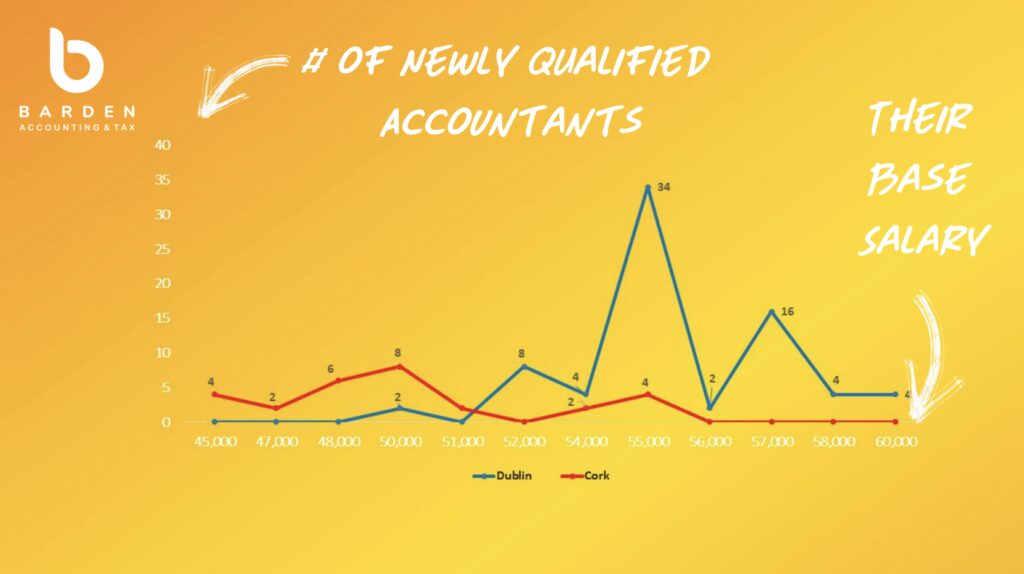
Interesting, right?
Now here’s the two big caveats:
- Base salary is only a part of Total Compensation – want to know about total comp for newly qualified accountants? Ask one of our experts in Barden and they’ll set you on the right track when it comes to what to offer to make sure you get the best people to build your team.
- Sometimes…people get paid more for the same job in a different company. Why? One of our experts would love to shed some light on this for you.
It’s not all about the base in someone’s first move after qualifying…but base sure is important! If you’re curious, want to learn more and what to base your decisions on actual data, you know where to go….
With so many different aspects of leadership to juggle on a day to day basis, sometimes leaders don’t have the luxury to stop, breath and reflect on how they could do things differently, or better, especially when it comes to their finance teams.
But we all know that without great teams, who are delivering their best, there is no great business!
To help we asked our partner John Slattery, of INSPO, about his views on leadership and helping your team to be the best that they can be. Here’s what John had to say…
Involve Rather Than Tell
Often when things get super busy activity can fall into the tell category. When you and your team are up against the wall to deliver on tight timelines you may feel there isn’t time to involve. In my experience this is the time when it matters the most.
It’s vital to involve staff in decisions and in creating solutions so that they feel part of that process, and the team. The other wins are that they learn, develop and up-skill when it comes to decision making and solution creation. The earlier they start this in their career the better for all involved.
It’s also great to remember…
“..that people will forget what you said, people will forget what you did, but people will never forget how you made them feel.” Maya Angelou
Actively involving will without doubt make your team feel better, and support them being at their best.
Walk the Talk
Another important one – especially for leaders. In my experience, as an employee and working with businesses through Inspo, leaders are seen as role-models and standard-bearers within a business. If a business invests in shaping its culture, or any contributing aspect of, leaders HAVE to embody it first. If leaders do, staff and teams are more likely to follow suit. And so, will begin the formation of a culture and lasting positive behaviours. This can only mean good things for your team.
Live & Breathe the Culture
Following on from the tip above, the culture of a business is key in determining its success. How do you create and shape this intangible concept within a business?
For me, it’s the product of four factors. Firstly, it’s having a vision for the business that can inspire all. The second factor is a set of values that I would see acting as a ‘moral compass’ for the behaviours and thinking within a business. The third factor is a mission statement that clearly states how an organisation wants to conduct its business each and every day to make the vision a reality. The last factor is honouring the purpose of the business.
The purpose is the ‘why’ statement – the fundamental reason for the business ever coming to existence in the first place.
A business may have some or all of these factors in place. What’s most important is how seriously they are taken – irrespective if there is only one or four in situ. The culture of a business will be driven by the combination of the quality and life given to whatever of these four factors are in place.
As a leader you have a responsibility for living and driving the culture. Lead by example and your team will naturally follow. And so will the space for them to be the best that they can be.
Trust Builds Successful Teams
In a recent “Leadership” post by Forbes they revealed that “nearly one third of employees don’t trust management”. How can staff, teams and businesses succeed if trust doesn’t exist?
Trust is a core personal value of mine and one I believe underpins success in leading a team, and ultimately the success of the business.
I could talk ad nauseam about the Trust Equation and other models that offer guidance on how to create a trusting environment within a team and business. For now, I’d like to highlight the importance of one aspect of the Trust Equation. That is ‘self-orientation’. In simple terms, this is the extent you focus on yourself or others in how you maintain and grow relationships.
The Trust Equation strongly indicates that the more you show real consideration for others the more trustworthy you are seen to be. Whether it be shaping a culture or having a career conversation with a staff member, being sincerely interested in, and taking positive action around the views, ambitions, ideas and concerns of others is going to support the creation of a trusting environment. Understanding and supporting their ambitions will naturally lead to the creation and development of trust.
And the payback for the creation of this trust is likely to come in the form of greater levels of commitment from staff and willingness to go the extra mile for the business.
Want More Insights and Support in Leading Your Teams?
Barden and Inspo have a common drive. Barden helps companies build great teams and Inspo helps teams to be great, together. Simple.
If you’d like to hear more about this work feel free to contact Ed Heffernan in Barden, or John Slattery in INSPO.
Read about Barden and INSPO’s partnership here.
For more great insights on leading your team visit our blog section here.
An easy interview.
By this, I don’t mean one that went well, I mean one that didn’t make them sweat.
Top Talent Wants Challenge
Think about it. Top talent doesn’t just move jobs, they want a new challenge. And the judgement on whether a role is right for them, can often come down to the interview process. How will they see you – as a potential employer – as potentially challenging enough for you, if you don’t give them a (little) bit of a hard-time at interview?
Top Talent Knows Where They Can Add Value
They don’t usually like BAU. Top talent wants something to get their teeth stuck in to. They will be eager to see where their potential development points are. This doesn’t mean you need to give this to them on a plate, make them prove it. Give them a case study, or talk them through a business problem and ask them what they would do.
Top Talent Wants a Career Path
A more obvious one, but with a slight nuance. This isn’t about false promises. If they think you, as their boss, don’t ‘have a plan’, then they may see nowhere to advance. It’s important to communicate how you see the development of your team as a whole, including your own path, to ensure that you, truly, are focused on real career development.
Top Talent Needs to Feel Uncomfortable
No need for trick questions, but you do need to push them outside of their comfort zone. This can be achieved in a non-confrontational way by just pushing them on technical questions, sitting down with HR to prepare a list of questions related to your priority competencies, or asking them to prepare a short presentation on an initial 30-day plan.
The critical thing here is that you don’t give them an easy ride. Of course, you can still build rapport, and yes, of course, you can keep it light, but keep it to the point. Ensure you question, challenge and really present your best side. Much like a Board meeting, you need to ‘wow’ to get the best results. Focus on your leadership pitch, gravitas and ability to build a sense of purpose. And don’t, whatever you do, give them the job after the first interview!
Good luck!
Barry Schwartz’s “The Paradox of Choice: Why More is Less” is one of those seminal reads that seems to be even more relevant today, than when it was originally published in 2004.
In it, Schwartz critiques the very heart of Western culture – the idea that in a free society, we have more choices than ever, yet we’ve never been less happy or satisfied. From this platform, he uses this concept to explain a number of feelings that are typical of our current world – such as the feeling of being ‘connected’ (via technology) but less able to ‘connect’ with people (or at least experience it in the same way as we did pre-technology) and the rise of depression, anxiety and general feeling of dissatisfaction, which he sees as, in part, a result of increased choice making people more likely to place blame on themselves when something goes wrong, or isn’t as they expected.
At the core of Schwartz’s argument is the idea that with more choice, we are more likely to either be paralysed (by too much choice) or disappointed (as we will always think that we didn’t make the best possible choice). This is an idea, that as recruiters, resonates with us profoundly – in fact, we see it every day when it comes to hiring and building your team. But how?
Let’s take a look.
#1 Choice
When you decide to hire, you have a choice. Taking aside any specifics on the ‘supply’ levels of the type of hire you are trying to make in the market (easy to find or hard to find – supply vs. demand), the fact is that people are more ‘available’ these days due to social media and online platforms. Which makes the perception of choice – at least on the surface – much larger when it comes to hiring. This is especially relevant at the senior end of the finance market. If you are hiring for a Head of Finance, you will likely have a high supply of candidates – resulting in, guess what – a massive amount of choice.
#2 Decision
Which, as Schwartz would tell us, can lead to paralysis. Faced with high levels of choice, decisions become a lot more difficult to make, as we become fixated on either the fear of making the wrong decision, or on the lure of making the ‘perfect’ hire. Like Schwartz compares the quest to find the ‘perfect’ pair of jeans, during the process of realising there is so much choice, the risk is that your initial expectations may become heightened to such a degree that only ‘perfect’ becomes the right answer.
Take this supply away – and the choice becomes easy to make. For example, if you’re recruiting for a Newly Qualified Big 4 Accountant, or a part qualified accountant, you’ll likely only have 2-3 to choose from. With a senior hire, you could sit there and interview for days.
#3 Timing
This leads me to our last point. Paralysis caused by too much choice doesn’t only lead you to question your decision, it leads you down to road of potentially missing out on what you wanted in the first-place – due to delayed action. Again, this is a situation experienced quite a lot at the senior end of the market, where candidates may lose interest or trust in protracted recruitment processes. Even at salary levels where there are less roles (lower demand), the strongest candidates will always be hired quickly – so if you leave it too long- you may not have the choice you initially thought you might.
What’s the takeaway here? Understand the paradox of choice. It may seem like you have more choice, but be careful to use it sensibly, and don’t let it paralyse you. Be careful not to translate choice into a quest for that all too illusive ‘perfection’. And finally, be cautious of timing – this is the factor that de-rails the benefits of choice – so act with speed and don’t let delay become the cause of your recruitment woes.
Watch more here
Barden Cork is proud to announce the appointment of Aideen Murphy (ACA/CTA) as Partner (Tax & Practice)
Aideen trained in tax through Deloitte (Qualified in 2012) and spent some time in financial accounting and analysis in industry (Mondelēz International) before moving to tax and practice recruitment in 2015.
In her new role Aideen will work very closely with Kate Flanagan (CTA) in Barden Dublin, creating a truly unique, national recruitment service for the tax and accounting practice community. Aideen & Kate are, individually, the most experienced tax and practice recruitment experts in Ireland and, combined, create something truly unique to the Irish recruitment market.
In Cork, Aideen will be supported by Jonathan Olden & Ed Heffernan and her remit will cover tax and accounting practice recruitment and advisory services. Aideen is trained in the Barden Career Model ™ (here >>>) and will use same to coach and mentor tax and practice professionals across Munster.
Aideen joins Jonathan, Ed, Denise Lehane and Sarah Barry (ACA) as the latest member of the rapidly growing Barden Cork recruitment practice.
Welcome to Barden Aideen!
