

 Jump Back

Open almost any CV or LinkedIn profile today and you’ll see AI sprinkled everywhere – Python, TensorFlow, LangChain, LangGraph, “worked with LLMs,” and so on. But not all AI experience is the same. That distinction matters whether you’re hiring or trying to break into AI-focused roles.
In this post, we’ll look at what an AI-focused software engineer actually does, how this role differs from others in the ML ecosystem, and how to evaluate or grow into these positions.
What Is an AI-Focused Software Engineer?
A software engineer working in AI/ML is, first and foremost, a builder. Their work doesn’t stop at models or experimentation – they ship features that users actually interact with.
Think of them as engineers who take AI out of notebooks and into real products. They design and implement applications where AI isn’t an afterthought but a core feature. They integrate models into production systems, deploy them via APIs and cloud infrastructure, and think holistically from problem definition all the way to user experience.
In short: they turn AI into things people can use.
How They Differ from Traditional Software Engineers
Traditional software engineers focus on building applications, services, and APIs without necessarily touching machine learning. They care about performance, scalability, maintainability, and UX.
AI-focused software engineers still care about all of that – but they also navigate a new set of trade-offs. Latency vs. accuracy. Cost vs. capability. How to design workflows like RAG or intelligent search so that the AI feels seamless inside a product. It’s the same engineering foundation, but with an extra dimension layered on top.
This distinction also came up in our recent Future of Tech series, where the team explored whether AI could replace junior developers – ultimately reinforcing that real engineering judgement is still essential when bringing AI into production.
Where People Get Confused: Data & ML Engineers
This is where titles often blur. The day-to-day reality of a data engineer, an ML engineer, and an AI-focused software engineer can look adjacent, but the goals are very different.
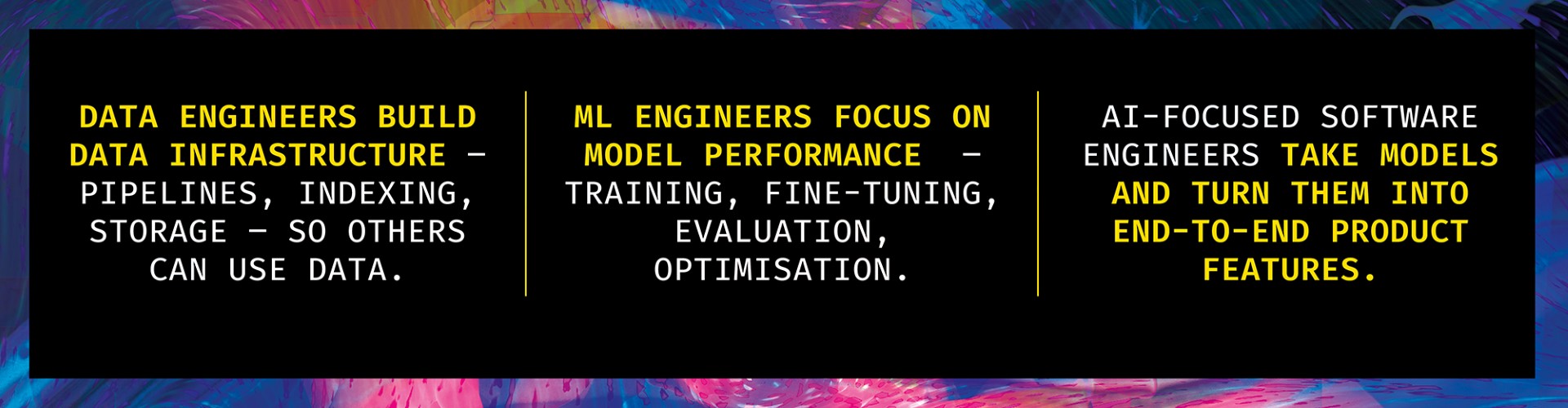
All three roles overlap, but only one is directly responsible for delivering user-facing AI functionality.
For Hiring Managers & TA Teams: What to Look For
When reviewing CVs or interviewing, the strongest signals for AI-focused software engineers include:
- Comfort with system design, APIs, deployment, and CI/CD
- Practical use of AI/ML libraries to solve user-facing problems (e.g., NLP search, AI-driven workflows)
- Experience integrating models into full-stack or microservice environments
- Clear evidence of ownership from data → model integration → deployment → product impact
By contrast, talent who lean heavily toward data engineering or ML engineering usually emphasise ETL pipelines, schema design, training workflows, evaluation metrics, or experimentation – with less focus on deploying features to users.
A representative tech stack for AI-focused software engineers often spans both engineering and AI layers:

Put simply: ML engineers focus on making models great; AI engineers focus on making them useful.
For Engineers: How to Grow Into These Roles
If you’re trying to stand out as someone who can deliver AI products, focus on building end to end.
Get hands on with retrieval pipelines, guardrails, prompt engineering, and monitoring. Don’t just train a model – deploy it somewhere, wrap it in an API, and show the product impact. Learn the ecosystem around cloud ML tools like SageMaker, Vertex AI, or Azure ML. And keep sharpening your foundation in system design, APIs, and microservices.
As highlighted in our recent Future of Tech series, sustainability is becoming an engineering concern too – the AI features you deliver also rely on energy-intensive infrastructure, and the best engineers understand the cost and environmental implications of the systems they build.
The engineers who can bridge AI and production software are the ones who differentiate themselves today.
Why This Distinction Matters
For companies, mis-hiring slows AI projects. You need engineers who can bring AI to production – not just experiment.
For engineers, positioning yourself correctly helps you stand out from pure data or ML roles and signals that you can turn AI into real product value.
Because at the end of the day, the important question isn’t “Do you know AI?”
It’s “Can you build something with AI that people actually use?”
Connect with Rachel on LinkedIn or contact her at rachel.mcguckian@barden.ie