

Barden are delighted to be partnering with a global business in the energy technology space as they seek a Revenue Accountant to join their team in Cork on a 12 month contract basis initially. This role offers the chance to work at the heart of a global finance function, partnering with cross-functional teams whilst playing a key role in revenue recognition and reporting.
You’ll be responsible for ensuring accurate and compliant revenue accounting across multiple entities, supporting month-end and quarter-end close processes, and contributing to continuous improvement initiatives within a global revenue team. You’ll also play a key role in commercial finance, partnering with FP&A and operational teams to provide insight on revenue performance, support forecasting and help drive informed business decision-making.
Key Responsibilities
- Manage revenue-related journals and ensure timely close activities
- Drive month-end and quarter-end processes across global entities
- Maintain and review revenue recognition models (ASC 606)
- Partner with FP&A, GBS, Sales, and Service Delivery teams
- Support forecasting of revenue impacts and contract evaluations
- Ensure compliance with US GAAP and internal controls (SOX)
- Prepare balance sheet reconciliations and revenue reporting
- Liaise with auditors for group and statutory reporting
What We’re Looking For
- Qualified Accountant (ACA / ACCA / CIMA or equivalent)
- Strong understanding of revenue recognition
- Excellent analytical skills with high attention to detail
- Strong stakeholder management and communication skills
- Ability to work in a fast-paced, deadline-driven environment
- Advanced Excel skills; Oracle or Alteryx experience a bonus
- 3+ years’ experience in a similar role (preferred, not essential)
Interested? Feel free to get in touch with Siobhán Sexton in Barden (siobhan.sexton@barden.ie) for more information.
Barden are partnering with a world-leading organisation with extensive facilities that support both sporting and agricultural activities as they seek to hire a smart and ambitious Financial Accountant to join their team in Tipperary.
This is a very broad role where the successful person will be involved in monthly reporting, involvement in the budgeting and forecasting process and project work while working as part of a high-achieving finance team.
You’ll work closely with all aspects of the business, gain exposure to decision-making and help shape the financial direction of a very unique business.
“The business is growing and we are looking for someone who is curious and wants to play a key role in the continued growth. I will support this person day-to-day.” – Finance Manager
ABOUT THE ROLE:
- Preparation of the month-end and quarter-end reporting processes
- Responsible for the preparation of management accounts for the business
- Key involvement in the budgeting and forecasting process
- Responsible for supporting and preparation of the statutory accounting activities for your assigned entities
- Liaise with auditors and support the audit process by providing timely and accurate information and data
- Act as a trusted business partner to all functions within the group.
ABOUT THE PERSON:
- Qualified Accountant (ACA/ACCA/CIMA)
- Naturally inquisitive mindset with a can-do attitude
- Excellent interpersonal and communication skills – the ability to work effectively with the wider team
- Strong commercial acumen
- Ability to act on own initiative.
Curious? Feel free to get in touch with Siobhán Sexton in Barden (siobhan.sexton@barden.ie) for more information.
Barden have been mandated by the CFO of a prestigious Aircraft Leasing company, headquartered in Dublin, to lead an exclusive retained search to support the appointment of a VP of Accounting. This is a unique opportunity for an ambitious finance professional to join a dynamic and forward-thinking organisation, to lead and develop the accounting function worldwide.
“We are looking to appoint an exceptional and driven senior leader at a pivotal moment in the company’s evolution, as we enter an ambitious new phase of growth. This is a unique opportunity for a strategic thinker with a hands-on mindset—someone who combines curiosity and vision with the pragmatism to drive meaningful change. You will play a key leadership role, shaping the future of the business while guiding and empowering a high-performing team. Your expertise and influence will be instrumental in scaling operations, enhancing performance, and delivering on bold growth objectives.” – CFO
About the Role
In a newly created role, you will be a key member of the finance leadership team, responsible for leading the accounting and financial reporting function worldwide. You will lead a high-performing team, ensuring robust financial governance, strategic planning, and insightful analysis to support the company’s growth and success.
About the role:
- Lead global accounting functions, including reporting, consolidation, and policy development.
- Ensure compliance with relevant accounting standards and support complex transaction accounting.
- Oversee financial close processes and preparation of periodic consolidated financial statements.
- Manage accounting aspects of asset transactions and lifecycle events.
- Liaise with auditors, regulators, and advisors on compliance and reporting matters.
- Maintain strong internal controls and ensure adherence to applicable regulatory frameworks.
- Collaborate with internal teams to support financial structuring and commercial initiatives.
- Enhance financial systems and processes for efficiency and scalability.
About the person:
- Big 4/Top 10 trained Qualified Accountant with at least 8 years PQE with strong working knowledge of aircraft leasing.
- Proven track record in a finance leadership role in an aircraft lessor.
- Strong technical knowledge understanding including leasing standards.
- Proven ability to succeed in a dynamic, high-volume environment with shifting priorities.
- Thorough knowledge of accounting principles and procedures essential.
- Excellent communication and interpersonal skills, with the ability to influence at all levels.
- Deep understanding of financial regulations and best practices.
Barden has been mandated by the CFO of a prestigious aircraft leasing company, headquartered in Dublin, to support the appointment of a Director Technical Accounting in a newly created role. This is a unique opportunity for a technically strong finance professional to join a sophisticated, global aircraft leasing platform at a key point in its growth.
This role will sit within the global accounting and financial reporting function and will act as the organisation’s internal authority on complex, judgement‑driven accounting matters, supporting transaction activity across the business.
“As we continue to scale the platform and execute complex transactions, we are looking to strengthen our technical accounting capability. This role will play a critical part in ensuring the quality, rigour and consistency of our accounting judgements, while partnering closely with our deal teams and auditors.” – CFO
About the Role
Based in Dublin, this role will provide deep technical accounting expertise across the group. While operating at a senior level, this is primarily a hands on, individual contributor role, with significant exposure to transactions, complex accounting matters and senior stakeholders across the business.
You will work closely with accounting, deal, treasury and finance leadership teams to ensure high‑quality accounting outcomes in a dynamic, transaction‑driven environment.
Key Responsibilities
- Act as the go to expert for complex, judgement‑heavy accounting matters within a large‑scale, asset‑backed international business.
- Shape and evolve the organisation’s technical accounting framework, ensuring consistency, robustness and alignment with leading practice.
- Lead the development of clear, well‑structured accounting position papers on complex, high‑impact transactions.
- Work closely with transaction and investment teams, influencing decision‑making by providing early insight into accounting and reporting implications.
- Build strong relationships with external auditors and advisors, confidently leading discussions on complex accounting judgements during reporting cycles.
- Play an integral role in enhancing the quality and transparency of statutory reporting, particularly in areas involving valuation, impairment and revenue treatment.
- Drive continuous improvement in governance, controls and documentation standards across the finance function.
- Partner collaboratively with finance, treasury and commercial teams, contributing to broader business objectives.
- Support finance transformation initiatives, including systems enhancement and automation, to enable future growth and scalability.
About the Person
- Professionally qualified accountant (ACA, ACCA, CPA or equivalent) from Big 4 or Top 10 firm.
- At least 7+ years experience in Aircraft leasing or audit/technical accounting in Aviation advisory.
- Deep technical accounting expertise, paired with strong commercial judgement and practical application of standards.
- Proven ability to form, articulate and defend accounting positions with senior stakeholders and external auditors.
- A confident, engaging communicator who enjoys translating complex technical matters into clear, actionable insight.
- Detail‑driven, resilient and highly professional, with the credibility to operate effectively under pressure in a fast‑moving environment.
We are delighted to be exclusively partnering with a high-growth, private equity-backed business at an exciting stage of its evolution. Following recent investment and a series of acquisitions, the organisation is entering a new phase – focused on scaling, integration, and building a robust group structure.
As part of this, they are now looking to appoint a Group Financial Controller to act as a true number two to an impressive Group CFO.
The Opportunity
This is a pivotal role within the business, offering the chance to:
- Take ownership of the day-to-day finance function
- Bring structure, governance and discipline to a rapidly evolving environment
- Play a key role in integrating newly acquired businesses
- Build and shape a scalable finance function from the ground up
The organisation is high-growth and acquisition-led, with further deals in the pipeline and a clear ambition to significantly scale in the coming years.
Key Responsibilities
Lead the day-to-day finance operations, including:
- Month-end close and reporting
- Cashflow management
- Financial controls and governance
Drive improvements across:
- Processes, timelines and reporting quality
- Budgeting, forecasting and performance analysis
Manage and develop the existing finance team, including:
- Reshaping team structure
- Introducing greater rigour and accountability
Support post-acquisition integration:
- Standardising processes across entities
- Embedding consistent reporting and controls
Partner closely with the CFO:
- Enabling them to focus on strategy, growth and investors
- Review and enhance the current systems landscape over time
About You
You will likely bring:
- A professional accounting qualification (ACA or equivalent) with circa 6+ years PQE in industry
- A strong financial control background with hands-on experience across the full finance lifecycle
You will be:
- A self-starter with a “gets it done” mindset
- Comfortable operating in fast-paced, evolving environments
- Confident in driving change and challenging when needed
- Pragmatic, commercial, and solutions-focused
Experience in M&A environments or integration work would be an advantage, but is not essential.
Barden are delighted to be engaged exclusively by a highly prestigious and successful Cork business to identify a Financial Controller. This role sits in the heart of business and will offer a significant amount of commercial exposure as well as typical financial control responsibilities.
The Financial Controller will partner with an impressive CFO and senior management team who promote a positive and collaborative culture. This is a broad role which involves delivering high quality financial reporting, ensuring strong financial governance as well as providing value-add information to make a real impact on the decision making of the business. This will suit someone who is technically strong, commercially minded with a great energy to bring to the team.
This is an exciting, high-impact opportunity for an ambitious finance professional looking to take the next step in their career. If you would like to hear more on this opportunity, please get in touch – caroline.frawley@barden.ie.
ABOUT THE ROLE
Responsibilities will include:
• Responsibility for monthly and year end reporting, investigation of variances and overall results to assist business performance
• Continuous improvement initiatives, developing best-in-class reporting to enhance the control environment and improve all elements of financial information
• Responsible for regular commercial reporting to Executive management providing insights that are accurate and timely to support strategic planning and decision making
• Take a lead role in the preparation and coordination of the budgeting and forecasting process
• Provide strong balance sheet and working capital management
• Play a key role in the preparation of statutory accounts and management of the external audit.
• Ad hoc duties and projects to support the growing needs of the business.
ABOUT THE PERSON
• Professional Accountancy qualification with 5+ years PQE
• Strong interpersonal and communication skills with attention to detail
• Organized and efficient with ability to prioritize workload and follow through on tasks
• Strong technical skills
• Positive attitude with a high level of personal integrity
• Proven ability to influence at all levels in the organization
Barden are delighted to be partnering with a global business in the energy technology space as they seek a Financial Accountant to join their team in Cork on a 12-month contract. This role offers the chance to work at the heart of a global finance function, partnering with cross-functional teams whilst playing a key role in the reporting process.
You’ll be responsible for ensuring accurate and compliant accounting across multiple entities, supporting month-end and quarter-end close processes and contributing to continuous improvement initiatives within a global team. You’ll also play a key role in supporting teams both locally and globally and help drive informed business decision-making.
Key Responsibilities
- Manage month-end journals and ensure timely close activities
- Drive quarter-end processes across global entities
- Partner with FP&A, GBS, Sales, and Service Delivery teams
- Ensure compliance with US GAAP and internal controls (SOX)
- Prepare balance sheet reconciliations and revenue reporting
- Liaise with auditors for group and statutory reporting
- Ad-hoc project and tax work as required.
What We’re Looking For
- Qualified Accountant (ACA / ACCA / CIMA or equivalent)
- Excellent analytical skills with high attention to detail
- Strong stakeholder management and communication skills
- Ability to work in a fast-paced, deadline-driven environment
- Advanced Excel skills; Oracle or Alteryx experience a bonus
- 3+ years’ experience in a similar role (preferred, not essential)
Interested? Feel free to get in touch with Siobhán Sexton in Barden (siobhan.sexton@barden.ie) for more information.
Do you want to make a significant impact in a dynamic, globally focused environment? We are delighted to be partnering exclusively with a prominent global pharmaceutical solutions organisation in their search for an ambitious individual to step into the role of Financial Accountant to support the continued growth of the business.
This business is a key player in the pharmaceutical industry. With a revenue exceeding $200 billion, they are dedicated to revolutionising healthcare worldwide.
This is very much a varied role where the successful person will have full remit to make it their own. This person will get exposure across the global business while liaising with multiple teams across finance and beyond.
ABOUT THE ROLE:
- Preparation of the month-end and quarter-end reporting processes
- Responsible for the preparation of management accounts for the business
- Key involvement in the budgeting and forecasting process
- The development of strong relationships with key stakeholders across the business
- Liaise with internal and external auditors and supports the audit process by providing timely and accurate information and data
- Evaluation of processes and recommends and implements process improvements
- Responsible for supporting the Statutory Accounting Activities
- Ad-hoc project and tax work as required.
ABOUT THE PERSON:
- Qualified Accountant with post-qualification experience in industry
- Experience with SAP is a strong advantage
- Highly motivated self-starter with excellent attention to detail
- Excellent interpersonal and communication skills
- An effective team player, who demonstrates excellent leadership and negotiation skills.
Sounds interesting? Feel free to get in touch with Siobhán Sexton in Barden (siobhan.sexton@barden.ie) for more information.
Headline
The Q1 2026 data point is the most meaningful single quarter move on the curve since 2022, and the first clear signal that Ireland’s private/professional labour market has shifted out of the post-COVID “tight but cooling” phase and into something genuinely looser. Unemployment ticked up to 4.2% (from 3.6% in Q4 2025) while vacancies dipped to 1.01% – the lowest level since the 2020/2021 COVID period and below where vacancies have sat throughout 2024–25.
One quarter doesn’t make a trend, and CSO data this quarter is unusually noisy (more on that below). But the direction is clear and consistent with what we’re seeing across the market.
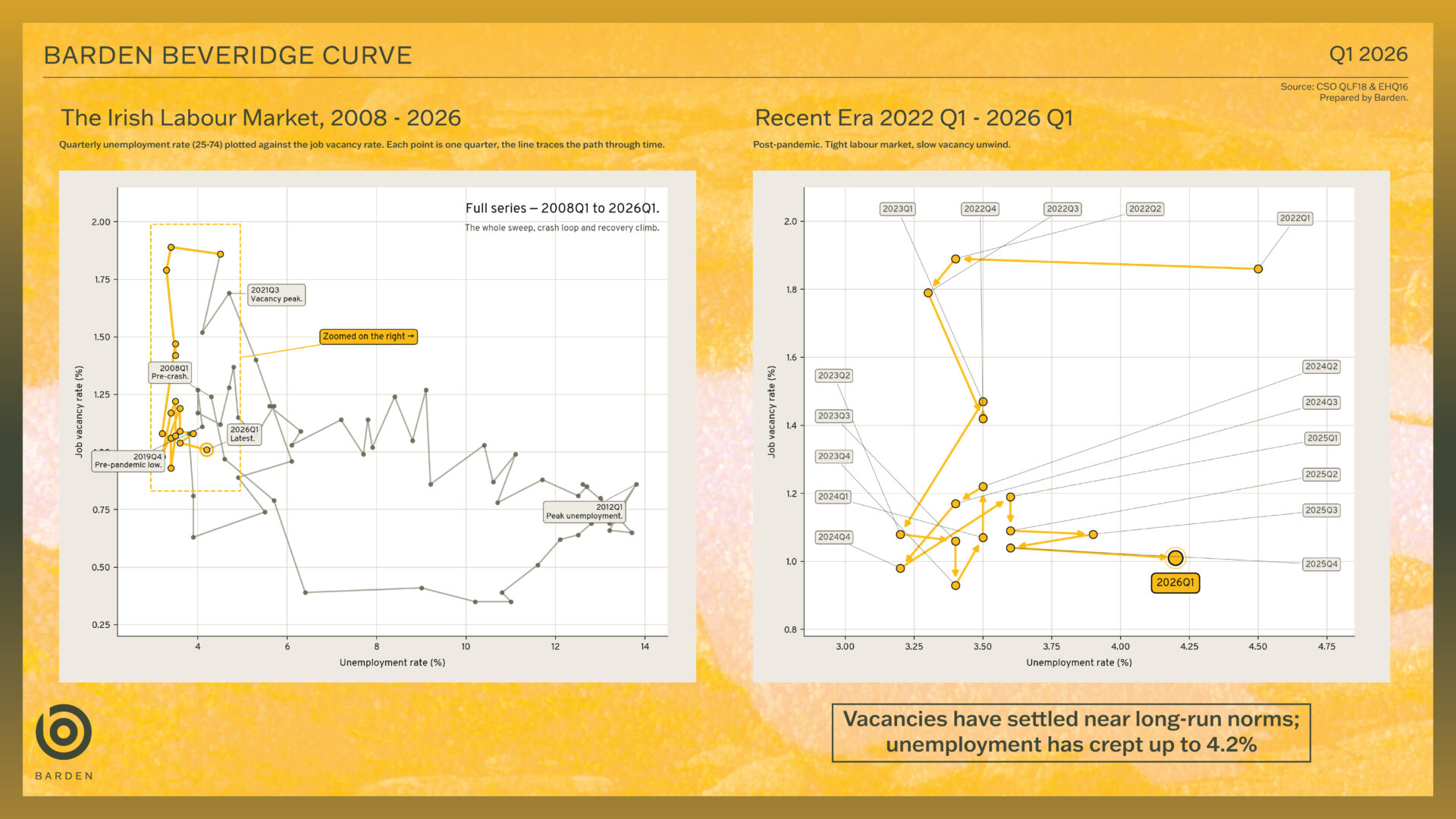 Period covered: 2008Q1 – 2026Q1. Private/professional sector (excludes public sector and related entities such as universities).
What the Curve is Telling us
A Beveridge curve plots unemployment against vacancies. It moves along itself with the business cycle (recession pushes points bottom-right, recovery pulls them top-left) and shifts when the matching efficiency of the labour market changes.
Three phases are visible in the Barden Beveridge curve:
- 2008–2019 — the long walk back. The curve traces a textbook recovery from the financial crisis trough (14% unemployment, 0.35% vacancies in 2009Q3) back to a tight market by late 2018 (~5% unemployment, ~1.5% vacancies).
- 2020–2022 — the post-COVID surge. After the COVID dislocation, the curve jumped to its tightest position on record. Vacancies peaked at ~1.95% in 2022 Q2 with unemployment at ~4%. This was the period of explosive hiring across tech, financial services, and professional services, when counter-offers, salary inflation, and 6-week placement cycles were the norm.
- 2022–2025 — the gradual cooling. Vacancies steadily declined from the 2022 peak, while unemployment remained in the 3.5–4.3% range. The points cluster in the top-left of the chart – still a tight market by historical standards, but normalising.
- 2026 Q1 — a step away from the cluster. This is where the new quarter stands out. Rather than continuing to drift gently along the curve, the point sits notably to the right and slightly below the 2024–2025 cluster. The unemployment move (3.6% → 4.2%, a 60bps jump in one quarter) is the largest single-quarter rise we’ve seen outside of the COVID period. Vacancies also stepped down from 1.04% to 1.01%, continuing a four-quarter decline.
Reading the Move
A few things are worth being precise about.
The headline CSO number is higher. The official Q1 2026 Labour Force Survey put unemployment at 4.9%, with employment down 0.6% over the quarter. The Barden curve uses 4.2% because we filter out the public sector and related entities to focus on the private/professional market we recruit into. The gap is informative; it suggests the softening is broader than just our segment.
The sectoral story matters. The CSO release flagged that the Information & Communication sector lost 20,300 roles in Q1 2026, a 10.7% drop, driven mainly by a 16,200 fall in computer programming and consultancy. That single sectoral move is having a big impact on the unemployment numbers. Pharma, medtech and financial services aren’t showing the same pattern, and construction employment is actually up 11.7% over the year. This indicates that the market isn’t softening uniformly; it’s softening in tech-adjacent professional roles specifically.
Volatility is genuinely at play. Bank of Ireland and others have noted that the LFS data this quarter looks noisy: full-time employment is up 1.5% YoY while part-time fell 5%, and the CSO’s payroll-based measure shows employees up 2.5% YoY. Q1 income tax receipts are up 6.1% to €8.7bn – not the kind of figure you’d expect alongside a genuine employment collapse. So the right reading is that something is moving, but the magnitude on the Labour Force Survey may be overstated.
That said, the Purchasing Manager’s Index (PMI) do echo some softness. The AIB Services PMI fell to a 7-month low of 50.7 in March 2026, with services employment falling marginally for only the third time in five years. Manufacturing PMI is still in expansion. So the broader picture is one of cooling rather than contraction, but the cooling is real, and it’s showing up in services.
What it Means Commercially
For the private/professional market we operate in, the practical implications are:
- The talent-led market is fading. For most of 2022–24, well-credentialled professionals in finance, tax, legal and analytics had multiple offers and significant leverage. The decline in vacancies (now a sub-1.05% trend) suggests that leverage is declining. Counter-offer rates and offer-acceptance dynamics will follow.
- Tech is the leading edge and is leading down. The Information & Communication contraction in Q1 is the same signal we saw first in 2008. When professional hiring softens, tech tends to move first because it’s the most discretionary and the most multinational-driven. Watch this segment closely; what happens here usually precedes the rest of the professional market by a quarter or two.
- Wage pressure should ease (but slowly). Historically, vacancy rates above ~1.2% coincide with strong wage growth. We’re now at ~1.01% and trending down. Newly-qualified professional salary inflation should cool first, with mid-level moves to follow. Top-of-market (experienced hires in scarce specialisms – tax directors, FP&A leads, in-house counsel) will likely remain tight.
- The Beveridge shift hasn’t happened. The curve has moved down and to the right along the cycle, but it hasn’t shifted outward (which would mean a structural mismatch – high vacancies and high unemployment). That’s a positive read: the market is loosening, not breaking. Matching efficiency looks intact.
What to Watch for in Q2 2026
- Whether the unemployment move sticks. A revised or revisited 4.2% (rather than a further rise) would suggest Q1 was a volatility blip on a softening trend, not the start of something sharper.
- Vacancy rate movement. A drop below 0.9% would be the first move into clearly “loose” territory by post-2018 standards.
- Sector spread. Whether the Information & Communication weakness pulls in adjacent sectors (consulting, financial services tech, fintech) or stays contained.
- NQ flow this autumn. With trainee accountants and solicitors qualifying in September, watch whether the destination mix shifts — fewer industry moves, more retention in practice, would be a real-time signal of a tighter hiring environment in industry.
Source: Barden quarterly Beveridge curve, private/professional sector (excludes public sector and related entities). Cross-referenced with CSO Labour Force Survey Q1 2026 (released 21 May 2026), AIB / S&P Global Ireland PMI releases, and commentary from Bank of Ireland and Deloitte Ireland.
If you have a request and would like real-time information to inform your hiring decisions, contact Ed Heffernan at ed.heffernan@barden.ie or Elaine Brady at elaine.brady@barden.ie
Barden is pleased to be partnering exclusively with a high-performing Irish organisation to appoint a strategic and commercially focused Financial Controller. The business has experienced significant growth in recent years and is well positioned to continue this upward trajectory.
The successful candidate will play a central role in both the day-to-day running of the finance function and the ongoing enhancement of systems, controls, and processes. In addition, they will provide meaningful commercial insight to support decision-making and help shape the future direction of the business.
This opportunity will suit an ambitious, entrepreneurial individual who brings energy, initiative, and a strong commercial mindset to their work. To explore this opportunity further, please contact caroline.frawley@barden.ie or denis.galvin@barden.ie.
ABOUT THE ROLE
- Leading and managing the overall finance function of an integral business unit within a large group.
- Ensuring the accuracy and integrity of financial reporting, with a focus on best-in-class standards.
- Ownership of cashflow management and working capital forecasting.
- Driving system enhancements and automation across the finance function.
- Regularly interact with senior leadership on commercial and strategic aspects of the business.
- Leading and contributing to key projects across both finance and the wider business.
- Ensuring full compliance with all regulatory and statutory requirements.
- Providing leadership, guidance, and development support to the finance team.
ABOUT THE PERSON
- Qualified Accountant with 5–10 years’ post-qualification experience.
- Strong analytical ability, with excellent communication and presentation skills.
- Proven track record of influencing stakeholders across an organisation.
- Commercially astute with a strong understanding of business drivers.
- Highly organised, with the ability to manage competing priorities and deadlines.
- Positive, proactive mindset with a focus on continuous improvement.
