


Your CV is just too important to leave to chance. It is the most personal document you will ever create. It represents your professional life story and holds the key to your future hopes, dreams and aspirations. It represents you when you are not in the room. It is what makes you stand out from the crowd. Get it right and it will work tirelessly for you. Get it wrong and it will close doors before you even get the chance to open them.
We work with trainee and part qualified accountants every day and have advised thousands of them on their profiles. Here is the best advice you can get to create the perfect part qualified accountant CV.
Step 1: Personal details, summary and education. If you do it right here is how it should look (pay special attention to the advice in red):
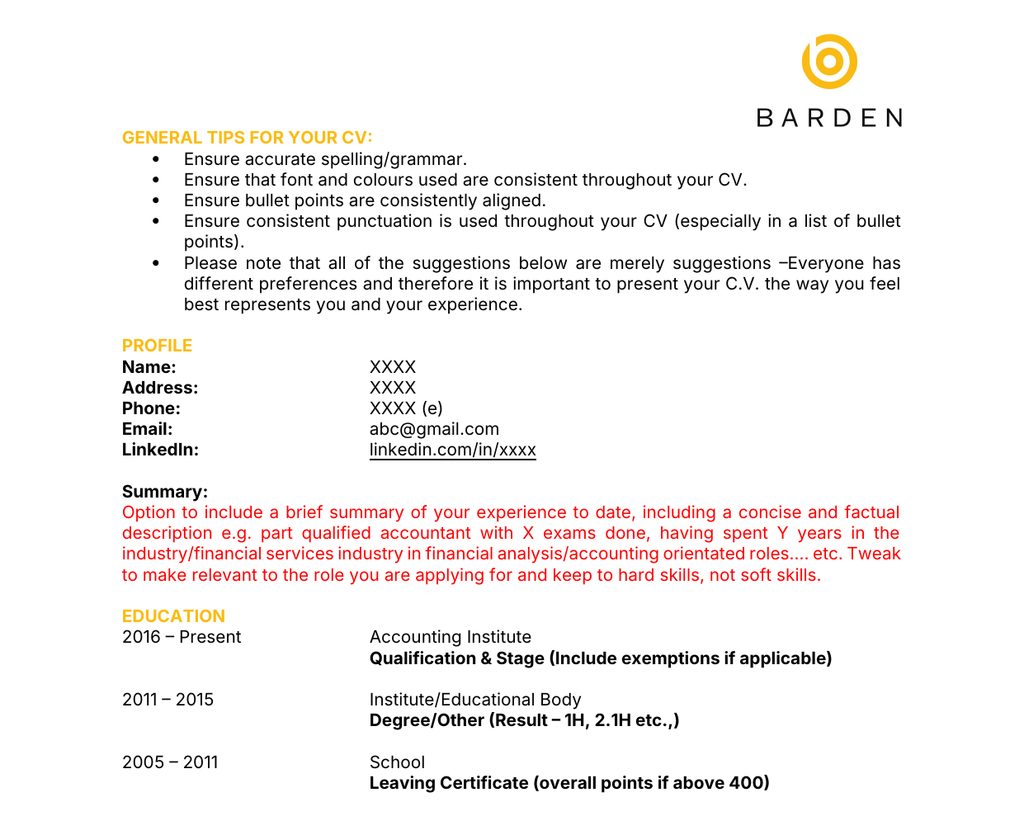
A couple of things you might have noticed:
- Address/Contact Information: Keep all to one line if you can. Page 1 is prime real estate so make sure you do not give up space easily!
- Professional Summary: Tailor this to suit the job you are applying for. Make it specific. Make it a place where you can highlight your suitability for the role. Beware of talking about soft skills here, as they are too subjective.
- Education: Reverse chronological order. Only include relevant education (if you did a barista course, that is lovely, but it does not deserve to go on the front page, unless you are applying to a coffee company!). Keep it simple. Bold the qualification and results.
- *Top tip: Make sure you indicate what stage you are at in your exams and when you expect to qualify (if you know). Say how many exams you have passed, how many you have remaining, and your expected completion date, for example “ACCA: 8 exams passed, 5 remaining, expected completion December 2027”. Even if you are only starting out in the exams, still put this in your CV. There is a big difference between someone who intends to become a qualified accountant and someone who does not (“Commencing ACCA exams in September 2026”).
Step 2: Experience: If you do it right here’s how it should look:
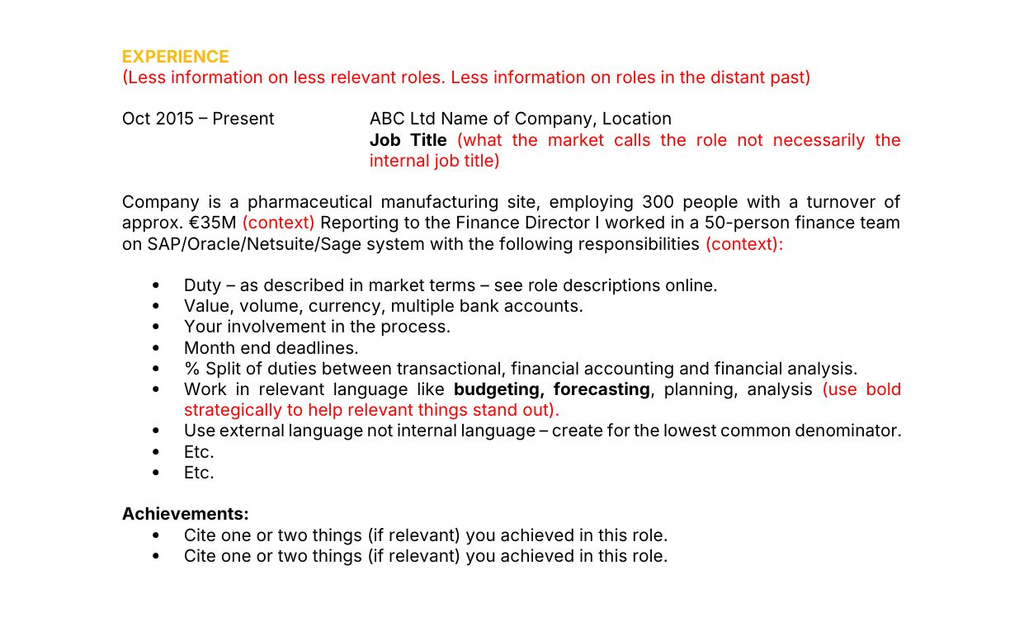
Some things that most people forget:
- Not everyone (in fact hardly anyone!) outside your current company will know anything about your company. This is where the intro line above is key. It is your chance to give context and to explain what ABC Ltd is and the structure you sit in (just as important as what you do!).
- Try to use common market language and not just lots of internal acronyms that nobody will understand externally. A good tip is to print out role specs for roles you are interested in and use their language to describe your experience.
- Make sure the number of bullet points you use for each of your duties is relevant to the percentage of your time spent on those duties. There is no point having 10 lines about AP and one about AR when you spend 10% of your time on AP and 90% of your time on AR. Putting in percentage-of-time indicators can be really handy too.
- Under achievements, make sure you call out any project work or extra things you are proud of. These should be short and speak to where you have gone above and beyond. Leave this out if you cannot point to anything of substance.
- *Top Tip: People usually get interviews based on their current or most recent experience. You might be tempted to put in loads of detail about the role you had in 2012, but the reality is that it is less relevant than the role you did last year. More detail for more recent roles; less (and maybe even only dates, company, and role title) for less recent roles. More detail for roles you spent more time in; less detail for roles you spent less time in. Follow these rules and you will be on the right track.
- **Top tip: Use AI as an editor, not an author. An application written by AI is easy to spot. AI tools can help you tighten a sentence, spot repeated words, or reword your duties in the language of a role specification. They cannot know what you actually did, so check every line for accuracy and never let a tool add skills, results, or figures that you could not talk through at interview. In our experience, profiles written entirely by AI tend to sound alike, and hiring managers notice. Keep your own voice and your own numbers. Take out personal details, such as your address, phone number, and date of birth, before pasting anything into a public tool.
Step 3: The other stuff: The decision to interview you or not will likely already be made by the time the hiring manager gets to this point in your CV. That said, it is a great place to talk about you as a person as well as a professional, it can provide great information to break the ice at interviews, and you might well be surprised at how much weight some hiring managers put on non-work activities and achievements. If you do it right, it might look like this:
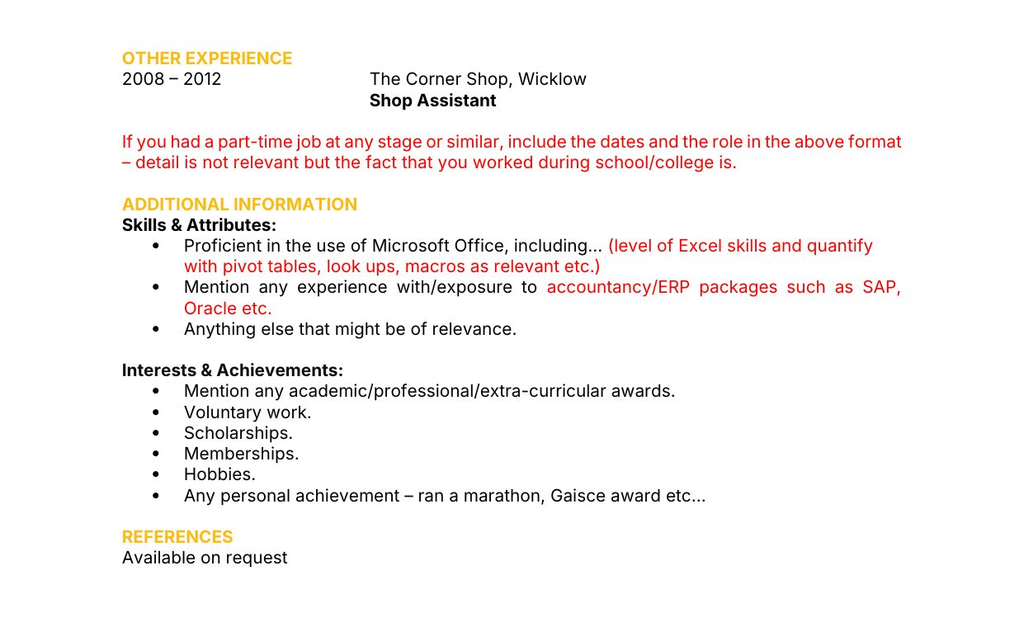
Profiles are simple in theory but can be very tricky in practice, and we have had a lot of practice at Barden. If you would like a Word version of this profile template, drop an email to hello@barden.ie and we will look after that for you.
If you are part qualified and would like a second pair of eyes on your own profile, you are also welcome to contact Sarah Griffin in Dublin at sarah.griffin@barden.ie or Tara Higgins in Cork at tara.higgins@barden.ie.

