

#1 Reflections on the 90-Year Evolution of the Accountant
Accountancy has been in my family for nearly 90 years.
How much has changed in the profession in that time?
When clearing boxes some years ago, I came across what can only be called a visible life cycle of the profession over 90 years. There was:
- Original ledgers from clients – big old red ledgers – DEBIT on the left page; CREDIT on the right. They were usually in pencil and balanced TO THE PENNY every time. Multiple pages and pages of neatly written records that served as the source data for building accounts.
- Typed copy of speeches given where there is reference to “the changing world that computers will bring to the profession” and how “these tools, which we at the moment are unable to predict where they will bring us, will enhance the profession and change the day-to-day workings of an accountant and auditor.”
- Letters to (and from) government ministers where the issue of trust and transparency in the profession and in all things nationally are endorsed and called upon to be maintained.
- Multiple references in speeches, articles and letters to the “constant need to review and enhance the training of our accountancy students”, ensuring they learn from “active engagement and participation of interactions with clients and senior members of the profession”.
All this may be interesting, perhaps only to me (and some fellow accounting nerds), I know!!
However, I bring it up now in the current environment, where we are seeing shifting sands not only in our profession but also in the national, economic, and socio-political landscape.
Daily, we seem to be presented with headlines of AI DOOM – that our jobs are in danger of being taken by AI (recent pieces here>>> and here>>>).
However, we seem to gloss over or ignore the headlines that show the potential AI is bringing to global employment
- WSJ – April 2026 – The New Jobs Being Created by AI
AI created 640,000 jobs between 2023 and 2025 in the U.S., according to an analysis by LinkedIn of job posting data.
- According to the World Economic Forum, while roughly 92 million roles will be displaced, 170 million new ones will be created by 2030 – net gain of 78 million.
- Indeed, closer to home, a PWC Ireland report (2025) noted that “AI can make workers more valuable, not less – even in the most highly automatable jobs”
Now, let’s filter this even more and consider how the shifting sands of AI will impact our profession.
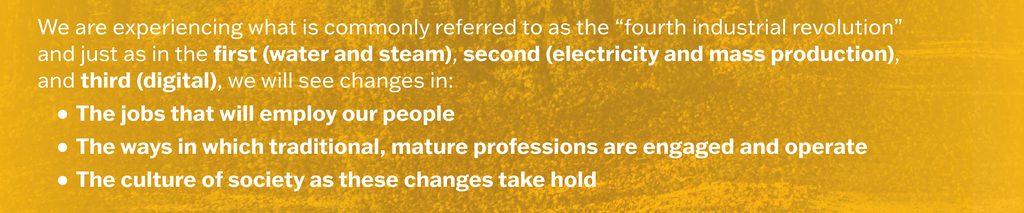
And as with all periods of change, it is how we best:
- predict the journey (and end destination),
- navigate the path, and
- adapt to the environment
that will determine the successful outcome.
Personally, I believe that this is, absolutely, a moment in time that will change our profession – but for the absolute better:
- AI will create more opportunities in the accountancy profession by shifting the focus from routine data entry to higher-value, strategic work.
- Rather than replacing accountants, AI augments the profession, freeing up time for services like advisory, business planning, and risk management
However, the narrative we are being bombarded with is “accountants will be replaced by AI”.
The ERROR in this statement, for me, lies in the fact that the term “accountant” is not understood or defined properly.
Entry-level bookkeeping tasks will be, and are being, heavily impacted by AI.
Data entry for compliance roles is being impacted by AI.
However… this is not what accountants do. This is the lazy perception – that accountants are just about the numbers – and data – and processes – and repetitive tasks…
THAT IS NOT WHO WE ARE!
Take the tagline from ACCA, which sums it up: Accountants are… more about advice than number-crunching.
It’s a common misconception that accountancy is all about maths. In reality, numeracy is important, but it’s only one of several required skills. Software (and now AI tools) does much of the number crunching in today’s accountancy firms, with team members increasingly focused on providing guidance to clients.
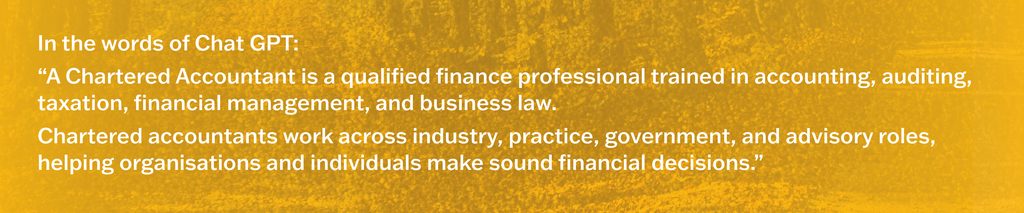
So much more than numbers. Indeed, it doesn’t even mention numbers?
Yes, it mentions financial management, but crucially, it expands on how we fulfil broader business, national, and global roles in driving success and growth.
So simply put – to define how AI is going to impact our profession, we must first:
- Clearly understand what our profession is and what we do?
- Identify the skills, within that wide berth, that can be better augmented by AI
- Identify the skills that AI will need human input for, to best synergise the effect
And then
- Ensure that we as a profession focus on, train and enhance those skills.
So let’s break this down into 2 parts:
- What is the role of the accountant, and hence what are the skills we need to focus on? Which tasks can be performed better by AI, and how can we introduce them to the profession in a responsible, ethical, and transparent way?
- What is the resulting picture of the accountant of tomorrow, and what MUST we do today to support this?
Role of the Accountant: the skills needed and the beauty that AI brings
An accountant is many things, but summed up best as a “Trusted Business Leader”.
An accountant, through their education and training, understands the fundamentals of reporting on a business and how to analyse whether a business is performing, growing, or meeting the set KPIs.
However, before that, the accountant needs to be able to:
- identify and define those KPIs
- define and design the strategy to achieve the strategic objectives
- lead out on the implementation of those strategies
- navigate change and transformation
- understand the implications to processes; people; supply chain; customers; growth targets, and then
- navigate as necessary.

Often, “the accountant” or “the CFO” becomes the owner of changing landscapes because of our innate and taught ability to navigate change.
We have seen it time and time again as the corporate landscape and structures have evolved.
- Before the CPO (Chief People Officer) became a C-suite role, it was often the CFO who was given responsibility for ops and people.
- During the first advent of technology, the accountant became the initial owner of IT, until the SMEs came onboard and the CTO became a C-suite.
- For sustainability, we became the owners of the changing world with SMEs now taking over.
- Now today, with AI, so often it is the accountants–in–practice, advisory firms or CFOs who are tasked with navigating the AI journey with the CEO.
Why is this?
Well, it comes down to our ability to predict and forecast changing landscapes.
Perhaps this comes from our budgeting skills? Maybe it comes from our need to fully understand the business to make financial decisions? But whatever it is, we are often the starting point for large-scale change journeys.
Our qualification supports this – we apply actions with logic, we learn to understand risk, and we balance the risk Vs reward conundrum daily.
Our qualification drills into us the need to collaborate – be it with customers, finance providers, shareholders, regulators – we learn that we are a part of a large ecosystem and how best to harness the skills around us – crucial in times of change.
Our qualification drills into us the need for clear, transparent and ethical thinking and actions. We have to be deliberate. We have to be doing right. We have to be transparent – our qualification does not engage with shades.
And as such, this is why “the boring accountant” is so often looked to as “the leader who can predict and navigate change” and why, in this time of immense change, the profession is at the forefront.
So, for such a broad ask, what are the key skills needed to be a fundamentally sound and effective accountant? In no particular order, I believe they are:
- Analytical Thinking – an ability to interpret financial and non-financial information and identify trends or risks.
- Problem-Solving – developing solutions to financial, regulatory, or operational issues. It’s happened for years – logic is the best starting point for solving problems and being a critical thinker – we are logical; we use facts, and we can break them down into solutions.
- Ethics and Professional Integrity – accountants are one of the most trusted professions, and it is critical to our development as a profession that we maintain this trust, confidentiality, and objectivity.
- Technical Accounting Knowledge – a strong understanding of accounting principles, reporting standards, and finance.
- Attention to Detail – accuracy is critical in what we do – decisions will be made based on the data and analysis we produce and the opinions we give – so we need to be clear, direct and outline any caveats.
- Communication Skills – often we will be the financial literate person explaining financial information to a myriad of stakeholders, and we need to be able to translate from facts (which may be financial or strategic) in financial speak to a language that our audience understands – perhaps legal, cultural, or transformational – but we need to communicate clearly to clients and stakeholders.
- Technology and Data Skills – we embrace changing technology and data skills – time and time again, the finance function has been the team most impacted by technology – from calculator to computer to ERPs to AI – it is the change again that we are trained to deal with.
- Commercial Awareness – understanding how businesses operate and generate value – we bring it all together to lead businesses into commercial longevity.
So, we now know what an accountant does – will this be replaced by AI?
It can’t be completely, and it won’t. However, we may need to shift the emphasis on certain skills.
I believe we can identify what tasks can be improved with AI, which will leave us time to focus on the tasks to develop more of to augment AI for our profession:
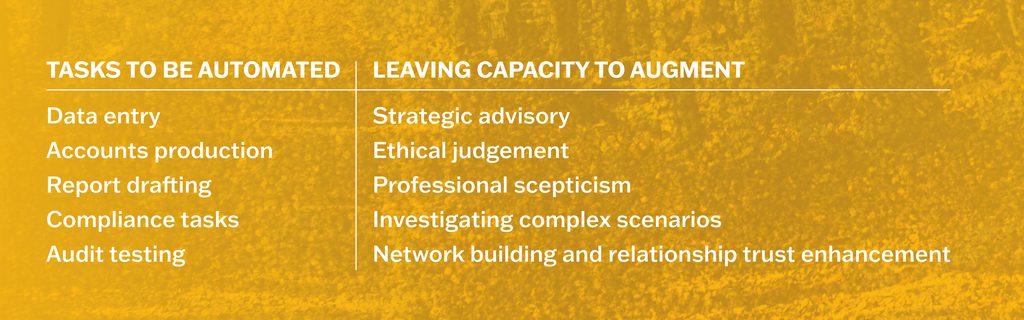
The above lists will grow – on both sides – and it is this changing landscape that we, as a profession, need to focus on, as it will dictate the skills we need to maintain and enhance not only to future-proof our profession but also to grow it.
Fundamental to this changing landscape is our role as trusted business leaders.
AI is only as good as the oversight, checking, and maintenance by humans.
We need to continue to ensure accountants are TRUSTED. One of the biggest issues with AI is the question of trust and what is real? The relentless march of AI is diluting “what is real,” thereby breaking the bonds of trust and of knowing what to believe. Our profession needs to ensure the progression of AI-driven output; tasks and processes are done in ways that can be trusted.
Chartered Accountants (according to the Edleman survey) are among the most trusted professions (ranked 3rd worldwide), and thus we need to maintain this trust by serving as the bridge between AI tools and generated data and human consumption and integration.
- We need to have the skills to robustly interrogate the data and ensure its integrity
- We need to own this space in a way that no other profession does.
So – how do we do this? How do we ensure that we marry this enhancement of AI tasks with the strengthening of the human skills that an accountant will bring to augment the AI / human journey in the profession, and in business as a whole.
Obviously, through the education and training of the Accountant of Tomorrow.
Accountancy Education will continue to develop and be enhanced.
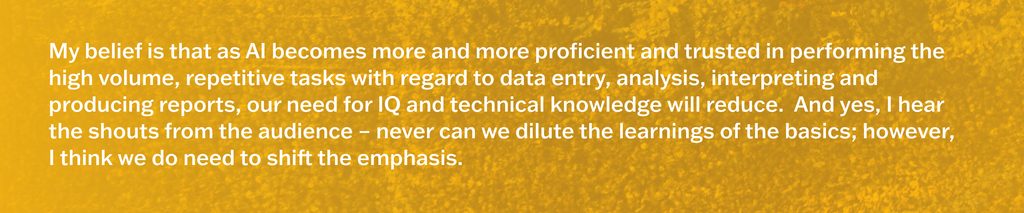
AI is already moving data from source, to ERPs, to interpretation, to production of reports. Where we, as accountants, need to be is in really being able to review, ethically integrate, critically challenge, and robustly present and use this information to advise, produce solutions to business issues, lead change and transformation that may come from it, and ethically represent all these actions human to human.
Thus, emphasis on education will, I believe, continue to shift to the more transversal skills that are needed in the profession:
- Critical thinking
- Problem solving
- Professional scepticism
- Ethical reasoning
Hand in hand with this focus on education will be the need to change the TRAINING of our next-gen accountants. The traditional model of 3 years training, where you have a junior learning repetitive tasks from a senior, is not going to cut it from a business perspective, as the lower-level tasks are no longer there for the technical on-the-job training.
However, what there is for on-the-job training is an emphasis on the above skills, which means learning how to work with and develop the very AI tools that will be used.
And I don’t just mean the large language learning (LLLs), I mean the audit integration tools, the generative AI tools that will produce insightful reports (believe me, these need to be checked and rechecked thoroughly), and the on-the-job learning will also be critical to enable our accountants to be brave in innovation, whilst navigating and understanding the risks that come with that.
And yes, I still hear the crowd shouting – “but how will they check this data output if they don’t know the basics” – well, they will be able to check it through credible stress testing for anomalies; by comparing and contrasting to other data sets, by really UNDERSTANDING the business, rather than just the numbers.
And this is where accountancy is truly at – it is not JUST ABOUT THE NUMBERS anymore. We are business leaders – trusted business leaders – and thus our training needs to support this. The tasks for the lower-level accountant have changed, and we need to embrace this. Potentially, we may not need to teach double entry shortly (heresy I hear) – and whilst I am sad about that, I understand it may be a fact – why teach an art form (or is it a science?) that will no longer be performed by humans. Take the time to teach empathy, negotiation skills, relationship-building skills, debating skills and ethical reasoning.
So, for me, the accountant who will be successful in the profession today and tomorrow will be LESS ABOUT IQ and more about being HIGH IN EQ, efficient in professional reasoning, skilled in critical thinking, and, above all, trusted by stakeholders because what they say can be supported and proven. These are the skills to be taught and practised, and for employers, these are the skills and traits to look for in your professionals.

If our profession and our businesses are to turbocharge their growth and leverage the opportunity afforded by AI, we must put AI front and centre, now.
We must:
- See AI as a tool for enterprise-wide transformation and not just personal productivity.
- Treat AI as a growth strategy, not just an efficiency strategy.
- Ensure your workforce has the skills to make the most of AI’s power.
- Not lose sight of the importance of overall governance to build and retain the trust needed to maximise the opportunity presented. And
- Ensure your team has the human skills and resilience to embrace these changes whilst ensuring transparency, ethical reasoning and appropriate judgements.
Sinead Donovan FCA is Strategic Board Advisor at Barden, former Chairperson of Grant Thornton Ireland, and Past President of Chartered Accountants Ireland.”
Barden Executive Search
Barden partners with Boards and executive teams to appoint leaders and build future-ready organisations. Our founders and senior leaders work directly with clients, bringing first-hand experience of scaling businesses and driving growth. Reach out to ed.heffernan@Barden.ie to connect. Your Leaders, found by Ours.