

In this episode of Leaders for Better, we sit down with our very own Elaine Brady -Co-Founder of Barden, Ireland’s partner-led talent advisory and recruitment firm, and a certified B Corp.
Elaine co-founded Barden alongside Ed Heffernan and Jonathan Olden with a clear conviction: that doing good and doing well are not in conflict. Over more than a decade, she has helped build Barden into a team of over 45 professionals and, in doing so, has developed a deeply considered perspective on what great leadership actually looks like in practice.
In this conversation, Elaine shares why she believes fit is the single hardest thing to hire for at leadership level and what the statistics say about what happens when you get it wrong. She talks about the leaders who have shaped her thinking, the time that tested Barden values, and how to retain culture as a company grows.
In your extensive experience of working with C-suite leaders, what are the traits of a successful leader?
The first one is definitely vision. The responsibility of the leader is ultimately to know where the organisation is going, and how to execute that vision or that plan. A leader without a vision is lost and never reaches their destination.
Another trait that I think is super important is empathy, or emotional intelligence — they are linked for me. In the current days of AI, whilst IQ is, of course, important, I think it will become less important. I think emotional intelligence and empathy will really help leaders succeed.
The third trait is being a really strong communicator. Somebody who can communicate the vision, but can also communicate with their teams so the teams understand where the organisation is going. Leaders need to be unafraid to have hard conversations when they need to be had, especially when those conversations are for the good of the person and the organisation.
What leadership trait is hardest to hire for?
At Barden, we very rarely bring leaders into the business on day one. We have a proven track record of bringing people into the business and helping them grow into leadership positions: people who have the right morals, the right values, the right purpose, and who are doing talent advisory for the reason that we do it, which is to make a difference in people’s lives. So we rarely hire leaders externally.
However, from my advisory work with external organisations and with clients, dealing with CEOs and boards, I think the leadership trait that they struggle most to hire for is fit. People look amazing on paper; they do excellently in interviews, and their skills are a match. But what organisations really struggle with is the fit piece.

It is very natural for people to come and go from businesses and this needs to be normalised. But when a leader leaves a business, it has a much, much higher impact, particularly when there’s a board or a share price involved. So, getting the leadership hire wrong can be hugely detrimental to that business.
How do you help your clients to assess “fit”?
When we’re advising CEOs and boards, we always tell them to be super honest with the person they are interviewing. Let them know the pros and the cons. Spend a bit of time during the interview almost trying to turn the person off the role. And if they come back still wanting it, then that’s amazing. Avoid painting a wonderful, lovely picture of how the organisation is — that’s not life, that’s not reality.
Challenges arise when there’s a mismanagement of expectations — when someone goes into an organisation on day one expecting something different from what they’re actually getting. If someone walks in with their eyes open, knowing exactly what they’re taking on, they have a far greater chance of succeeding. But if they’ve been shown a rosy picture where everything looks wonderful, that’s where expectations become misaligned — and it’s very, very difficult to come back from that.
What do leaders get wrong about the people in their team?
Leadership teams have two main challenges.
The first is hiring to reduce risk. Lots of organisations will hire leaders who are similar to themselves — similar educational background or professional training, because they think “well, I worked out, therefore this person will too and that minimises risk”. The reality is that it’s often not the case, as groupthink forms at the leadership level.
But leaders perceive it to be less risky to hire versions of themselves.
The second thing is that leaders tend to assume that people, whether at leadership or senior management level, are motivated in the same way they are. What we’ve seen through our work with Barden – thousands of hours with hundreds of leaders across different businesses in Ireland – is that people are motivated by different things. Understanding this is key to running a really successful business, rather than taking a one-size-fits-all approach, whether that’s a remuneration strategy, or assuming that because you want to be CEO, someone else in the senior leadership team wants that too.

We have particularly noticed this through our work with B Corps: it tends to be much further down the list than people expect. What talent wants is an environment where they’re respected, have some flexibility, and feel like they’re doing good by doing good. It is really important for leaders to understand how people are motivated — and that tends to be what determines how you retain and attract talent.
Did you choose leadership, or did leadership choose you?
I think I chose leadership. At the start of Barden, we didn’t have a grand plan outside of trying to make a difference in the lives of the people we get to work with — whether that’s from a talent perspective, a client perspective, or an internal teammate perspective. We just knew we wanted to build something really different.
When I started Barden, I was definitely much more focused on the day-to-day — probably what I would class more as management skills. As the business scaled and grew, I realised my job was to communicate the vision; that’s ultimately when I really had to focus on leadership and the leadership skills required to grow the business into what we want.
What is the best and worst leadership advice you have received?
Gosh, I could write a book on the amount of advice I’ve gotten, good and bad! I think the best piece of advice I ever got was from a mentor I had on a KPMG Going for Growth programme a number of years ago. She said: you cannot grow your business by still being in your business.
So, for me, that was an amazing piece of advice, and it really resonated with me. From that day, I spent the next number of years trying to create a structure that would get me out of the business day-to-day from an operational perspective.
The worst piece of advice I ever got relates to when we were starting Barden itself. When I tried to explain the concept and how different it was going to be from a traditional recruitment firm, people in our profession said: look, you cannot possibly run a recruitment firm that’s not based on KPIs, volume, and metrics. But I really believed — and I knew — that if we brought in the right type of people, we could run a business the way we envisioned. And I think we have proven over the last 12 years that that advice was absolutely wrong. It’s a good thing we didn’t listen!
How do you protect culture as Barden continues to evolve and grow?
For me, culture is the most important thing. I’ve often said – and I’ve seen it – that no one person in the business, regardless of how excellent they are at their role, is bigger than the culture.

As a business grows and scales, focus on finding like-minded people. We tend to try to encourage people who are very intrinsically motivated to join our business, which makes us very different to a traditional recruitment firm in that regard. But for us, if people really believe in what they do, what we do, and what we stand for as a business, then the culture gets stronger as we grow, rather than diluting as we grow.
How does being a B Corp certified business change the decisions you make on a day-to-day basis?
We are very proud to be part of the B Corp community and everything it stands for. We have always been the type of business that says internally, ‘you do good by doing good’ — that’s been one of our mantras since the start. So while our B Corp certification is relatively recent, I really feel we have lived those morals throughout Barden’s evolution. Now, I’m much more conscious of it, and of the responsibilities that come with it. Whilst the environmental and governance aspects of B Corp are important, I think for us, as a professional services firm, it’s our social impact that we really want to evolve and speak about more.

That’s also the reason we’re doing this Leaders for Better series, because we want to use our platform and our voice. We’re in a really privileged position: myself, the leaders we feature, and every one of the team at Barden all have a voice externally. It’s important for us to use it to elevate other organisations that are truly leading with purpose, values and morals.
There are other Irish-owned businesses with purpose and profit, like ourselves, but there’s no point having all this wonderful purpose if there’s no profit at the end of the day to let you keep doing that great work. Those are the type of organisations I want to support, to ensure they have the profit to fulfil their purpose.
Has there been a moment when your values were truly put to the test?
Definitely during COVID. Given the structure of our business at the time, essentially all revenue stopped overnight and remained halted for almost six months. We had over 30 people working with us at the time, and we felt that we were ultimately responsible for paying their mortgages, their bills etc. It was the first time we were ever tested morally from that perspective. Through our growth years, we said that we would always look after our people, and it was the first time we were ever truly tested. We got through that period and managed to keep everyone employed, which wasn’t really common in our industry at the time. We kept the entire team together. And I think we ultimately came out of it much stronger.
So that was probably the first time we really had to make that really tough decision — and we absolutely lived by it.
Is there a leader who inspires you and why?
Absolutely loads! First of all, as you can tell, I’m obsessed with female leadership and the “can’t see, can’t be” concept. I was very young when Mary Robinson became the first female President of Ireland, and I remember thinking at the time, how could a woman be president? It was just so groundbreaking. And not to mention all of her subsequent human rights and environmental work. I think she is absolutely amazing.
From a global perspective, I admire Jacinda Ardern. She personified what leaders should be. She is the perfect example of an empathetic leader, of someone who is highly emotionally intelligent. And I think she led New Zealand through probably two of the toughest things they’ve ever gone through as a country — the Christchurch mosque attacks and COVID. She led with such empathy. I think a lot of world leaders could really look to her leadership style, particularly in this day and age, and really learn a thing or two.
For her to choose to stand down when she felt she didn’t have the energy to do more — it was never about ego or her own legacy; it was about her serving her country and knowing when the time was right to pass the baton on to a different skill set, a different leader. I think that’s very rare and a true personification of a Leader for Better.
You often speak about The Mirror Test – tell us about that.
There is very little I actually remember from my four years of business studies at university! But one of the things I do remember was a motivational speech a lecturer gave us in our final year. He was trying to share with us the importance of the roles we might play in the future, whether in business, politics or industry. He talked about some of the most profitable businesses and the happiness levels of their leaders. And he gave us this concept: The Mirror Test. When you’re building a business, leading people, making profits, and doing well financially, look in the mirror.

The Mirror Test is so simple — keep checking in with yourself as you’re running your business, as you’re scaling your business. Do you like what you see, and are you still living what you believe?
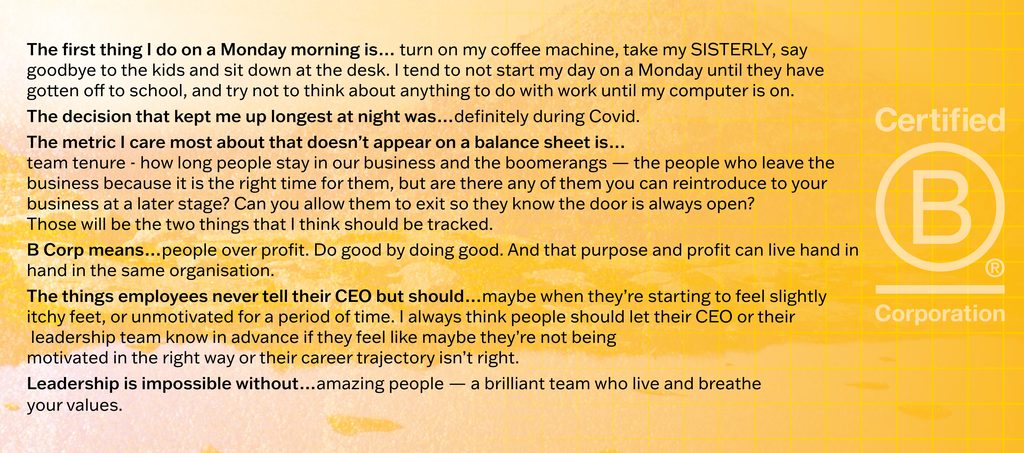
Leaders for Better is Barden’s series spotlighting Irish CEOs and changemakers who are proving that profit and purpose can coexist.
Derek F. Butler | GRID Finance read here>>>
Susie Horgan | Springboard Communications read here>>>
Daragh Anglim | Broadlake read here>>>>
Aoife Matthews | SISTERLY read here>>>>
Check out our other Leaders for Better Interviews on YouTube>>>